Showing posts with label theme. Show all posts

Wednesday, March 30, 2022

2022 Post #16 -- Giving a Song A Second Read

by Drew Sterner

As I typically do with poetry, we look at it twice. I will often have students read it first to themselves and jot down their quick reactions in their writer’s journal. Then, I will read it to them. A question we often start with after doing this is “How did my reading alter your original interaction with the poem?” Students can discuss their reactions in small groups, or we can discuss it as a larger group.

With William Carlos Williams “The Fool’s Song” it makes sense to take a moment to have students identify the metaphor as well as the use of repetition and why Williams chooses to do this in his poem.

I tried to put a bird in a cage.
O fool that I am!
For the bird was Truth.
Sing merrily, Truth: I tried to put
Truth in a cage!

And when I had the bird in the cage,
O fool that I am!
Why, it broke my pretty cage.
Sing merrily, Truth: I tried to put
Truth in a cage!

And when the bird was flown from the cage,
O fool that I am!
Why, I had nor bird nor cage.
Sing merrily, Truth: I tried to put
Truth in a cage!
Heigh-ho! Truth in a cage.

I like this poem though more for its message and the use of Truth as a metaphor. Hopefully by this point, a student has observed that Truth/the bird cannot be restrained. It is rife with opportunity for students to write about or discuss the many things in our lives/world that resemble this metaphor of things that we struggle with or perhaps shouldn’t try to restrain, as well as the many “truths” that fly around us in our modern world.

Students can also experiment with free verse after looking at this poem and create a similar type of metaphor and then compose a single stanza that emulates Williams’s style in this poem.

Further Reading:


Drew Sterner teaches ELA at the middle school level and is an advisor to the student-run school literary magazine, Roaring Voices Review.

Saturday, March 26, 2022

2022 Post #12 -- What Might We Spoil

by Nawal Qarooni

Sometimes when we read poetry, we leave with simply a feeling. The words feel less about meaning and more about emotion; the images conjured are raw and even very subjective. But with Hala Alyan’s poem, "Spoiler,” readers are left feeling some of both.

More than anything, the poem leaves us with a brutal truth as takeaway, a message I seek to elevate in the classroom.


I’m here to tell you the tide will never stop coming in.

I’m here to tell you whatever you build will be ruined, so make it beautiful.


This makes me think about intricate mandala art, sometimes crafted out of sand for hours and hours that then – poof– disappears in an instant. It reminds me of incredibly detailed nail art, that also takes hours to design, only to be chipped and removed before not too long. It elucidates the belief that journey is far superior to the destination; that there’s magic every step of the way.

Hala’s poem for me depicts a picture of truth across the board. There are sadnesses, nightmares, dying; trees planted in infertile soil. But the lingering image is one of building sandcastles so beautiful it doesn’t matter how intense the tide. At the end, she leaves us with the ‘spolier’ that in life, process is more important than the sum of those momentary products.


What Might We Spoil?

This lesson riffs off the idea that we embrace with open arms inevitable change.

With students in upper grades, you might use Hala Alyan’s poem as a springboard for writing their own ‘spoliers.’ To brainstorm, I suggest students draw a three-column chart - one with emotional moments that one might perceive as setbacks, one with life milestones they hope for, and another with potential lines to remix the idea of spoiling. What do we work so hard towards? What moments in our lives felt painful? What goals and life events are we seeking? What metaphors, like water destroying meticulously-crafted sandcastles, can we conjure to highlight the journey, and the idea that the steps along the way are important experiences worth painting positive?

With this mentor, students can organize their staccato sentences similar to Hala’s, maybe even leading with their own question, moving into moments of disappointment across time, to a final, purposeful metaphor at the end. After listening to Hala’s audio recording, I would have students record their pieces too.

There is beauty in ruins. There is beauty in the spoiling.

Further Reading: 


Nawal Qarooni is an educator and writer who works in education spaces to support a holistic model of literacy instruction. She and her team of coaches at NQC Literacy work with teachers and school leaders to grow a love of reading and composition in ways that exalt the whole child, their cultural capital and their intrinsic curiosities. She is the proud daughter of immigrants, and mothering her four young kids shapes her understanding of teaching and learning. Nawal’s first book about family literacy with Heinemann is forthcoming in 2023.

Friday, April 10, 2020

2020 Post #27 -- The Stories of Tattoos

by Brett Vogelsinger

One of my favorite poets I have discovered in the past few months is Ariel Fransisco.  I've shared several of his poems with my classes, but one short piece that provokes some great conversation and writing is "Poem Written in the Parking Lot of a Tattoo Shop While Waiting For an Appointment."  Sometimes when sharing a poem that is brand new to me for our Poem of the Day routine, is simply put the question to students:  What do you notice?  What should we talk about in this poem?

They are experienced readers of poetry by this point in the year, and invariably they find something I missed in my own reading of a poem.

In this poem, we end up talking about the speaker.  Is this the speaker's first tattoo?  Why is he getting one?  Will he go through with it? The line "I'm in search of any kind of permanence" becomes central to our conversation.

I ask students "How many of you will likely get a tattoo someday?  How many of you think you never will?  Why? And why are tattoos so popular right now?"  This could be a conversation or a writing prompt, but in the course of talking as a class, students began to tell stories of family members and their reasons for getting tattoos, some of which opened my eyes to people's quest for "permanence," often using tattoos to record a painful loss or deep devotion.  These personal stories  looped us back to talking about the speaker in the poem again.

Further Reading (out 4/21/20):


Brett Vogelsinger is a ninth-grade English teacher at Holicong Middle School in Bucks County, PA.  He has been starting class with a poem each day for the past ten years. He is the creator of the Go Poems blog and the author of Poetry Pauses: Teaching With Poems to Elevate Writing in All Genres.   Find him on Twitter @theVogelman.


Wednesday, April 8, 2020

2020 Post #25 -- A Poetic To-Do List

by Brett Vogelsinger

This week, two inspiring, creative educators -- Austin Kleon and Katherine Schulten -- brought a poem back to the surface of my attention that I had forgotten about for some time.  "Things to Do in the Belly of the Whale" by  Dan Albergotti is a bittersweet look at what we can do with a period of confinement, ennui, boredom.  In times like these, the poem feels both realistic and empowering; it is a poem that wears a wry grin. 

I brought this poem to my students during a live class meeting via video conference this week and asked a quick question after our first read. "Why do you think I chose this poem to read with you now?" Of course, that was an easy pitch, and students had no problem identifying links between the idea of being stuck "in the belly of the whale" and being confined during this period of stay-at-home orders and mass quarantine.  Fewer of them, though, were aware of the biblical allusion in the title, to the book of Jonah

A student read the poem a second time on our video conference, and I proposed this question: "What do you notice about the structure of this piece?  How is it built?" Your students may note the fact that is is a "to do list," it is made up of short sentences, and that each sentence begins with a verb, the grammatical structure of a command.  One student pointed out to my class that the first few items seem realistic, and the poem seems to become more whimsical, then more philosophical as the list progresses.  I thought this was a particularly astute observation.  

"Let's try writing one like this!" I said to my students.  "Call it something like 'Things to Do While Stuck at Home' or 'Things to Do During COVID-19.'  There is one catch.   Let's take the first three things that come to your mind and exclude them from our list.  We want to avoid stating the obvious in poetry."  All classes chose the same three things to exclude:  sleeping, watching TV, and playing video games.  

After a few minutes of drafting, I gave them an assignment to complete after our video conference class time ended.  Students could revise their first drafts and post the revised version on a collaborative writing space on OneNote.  I would provide feedback for everyone's revised drafts before next week.  

Here are some memorable excerpts, written by my students: 

Paint the walls. Sing in the shower. Pull weeds from the dirt. Buy a blanket to cuddle up in. Go for a run. Laugh with joy when you're with your family. -- Brielle G. 


Make your bed
Wash your clothes
Dust everything in your room
Because apparently
Your room is disgusting
Although you don't see it
Anyway
Build something with wood and nails
Doesn't matter what it is, just build
And finally
Make your family LAUGH -- Christian P. 


Pace the concrete sidewalk. Walk among the trees. Get out and live a little.
Try something new. Change your surroundings.
Look up and open your eyes. See the world around you. Move outside your bubble. -- Shayne S.


I am grateful for how this poem helped me to see my students' present situations and perspectives while also allowing us to talk about poetic structure, theme, and grammar.  It brought us back to a Writer's Notebook style of response that I have missed since our last day of school, which was refreshing and necessary and lively.  

Further Reading: 


Brett Vogelsinger is a ninth-grade English teacher and NBCT at Holicong Middle School in Doylestown, PA.  He is the founding editor of Go Poems, facilitates his school's literary magazine, Sevenatenine, and contributes monthly posts at Moving Writers.  You can find him on Twitter @theVogelman.  

Tuesday, April 7, 2020

2020 Post #24 -- A Diamond-Shaped Puzzle

by John Waite

Layli Long Soldier’s “Obligations 2” comes from her first full-length collection, 2017’s Whereas. It is an amazing poem that will challenge students on a couple levels. While the language is very simple, the structure is a puzzle with many answers. I can imagine students engaging with this poem both in terms of its content and its form. Possible discussion questions include:
1. What is the subject of this poem?
2. What is Soldier’s attitude toward grief?
3. How different are the different readings based on how you choose to progress through the poem? Is it possible for them to be contradictory?
4. Why would an author give the reader so much freedom in how to read a poem?
5. Since each reader can have a different experience, can the poem really be said to mean anything for certain?
6. What choices does Soldier make for the reader, and why?
7. How does Soldier’s choice of verbs help create complexity?
8. How does repetition function in the poem?
9. What word might you replace the word “grief” with?

Another possible exercise would be to have students try to create a similar poem, though possibly shorter.
Further Reading:


John Waite an English teacher at Downers Grove High School in Illinois.

Wednesday, April 1, 2020

2020 Post #18 -- I Am and I Am Not

by Linda Rief

COVID 19 has shut down many schools for the next few weeks, preventing so many of you from participating in those activities that make the school experience so important to you: athletics, drama, musicals, jazz band, orchestra, Mathcounts, Robotics, outdoor ed, community volunteer work, etc.

As you read the following excerpt think of the “Try This…” prompts in terms of what you are experiencing right now, at home or at school. You could start with the line “I am a… but…” or grab any one of the ideas and write as fast as you can, outrunning the censor in you that often stops the writing.

Read the poem out loud to yourself once. Then read the prompts underneath the excerpt, to see which one appeals to you the most. Then read the excerpt again, and write nonstop as quickly as you can for two to three minutes in response to any of the prompts. You are writing to find writing, trusting that the process will lead you to some surprises, some things you didn’t expect to write.

An Excerpt from Chapter 2 from The Running Dream (Van Draanen)

(from The Quickwrite Handbook, 2018, Heinemann)

I AM A RUNNER.

That’s what I do.

That’s who I am.

Running is all I know, or want, or care about.

It was a race around the soccer field in third grade that swept me into a real love of running.

Breathing the sweet smell of spring grass.

Sailing over dots of blooming clover.

Beating all the boys.

After that, I couldn’t stop. I ran everywhere. Raced everyone. I loved the wind across my cheeks, through my hair.

Running aired out my soul.

It made me feel alive.

And now?

I’m stuck in this bed, knowing I’ll never run again.


Try This (as quickly and as specifically as you can for 2-3 minutes):


Write out anything this excerpt brings to mind for you.

Borrow any line and write as fast as you can, letting the line lead your thinking.

Think about something you are passionate about (something that “airs out your soul,” “makes you feel alive”) and write down everything that makes this activity so important to you.

Start with the line “I AM A ___________ ", and fill in the blank, describing all that you do, think, feel, experience while doing this activity.

Change the line to “I am not a ____________", expanding on all the reasons why you are not whatever it is.

Her last two lines say she will never run again. What has stopped you, or has halted you temporarily, from doing something you love doing?


After finishing this one quickwrite, go back to see if there is a line or a phrase you want to slow down and develop. Write more. Or simply take some time to extend what you said in only two to three minutes.

Further Reading:


Linda left the classroom (reluctantly) last June (2019) after 40 years of learning from eighth graders. She misses their energy, their curiosity, and their desire to read and write. She is an instructor in the University of New Hampshire's Summer Literacy Institute and a national and international presenter on issues of adolescent literacy. Her latest two books are The Quickwrite Handbook (2018) and Read Write Teach (2014), both published through Heinemann. Her Twitter handle is @LindaMRief.

Monday, March 23, 2020

2020 Post #9 -- Adjusting to a Quiet World


Brett Vogelsinger retweeted this tweet from Jose Olivarez, and I was struck dumb for a moment:


I had never read this lovely poem, but it so played the right cultural and thematic chord (a government restriction on words, apparent social isolation, simplicity in community and love and humanity) that I instantly knew I was  using Jeffrey McDaniel's “The Quiet World” as the first poem in my distance learning plan.

Taking a page from Carol Jago, I wanted my students to simply experience the poem, and I wanted to give them two very simple directions. First, I invited students to tell me the line that struck them the most, something we always do in class when we first read a poem. The poem’s power is in its emotional use of language, which plays on the fact that conversation is limited to one hundred and sixty-seven words a day, so students’ choice of lines would be a wonderful entry point into thinking about the poem’s large themes of connection, love, and humanity. Once they’d chosen their line, I simply wanted them to tell me how this poem and its themes felt resonant during this pandemic where we are social distancing and distance learning.

The trick of this lesson was in how they shared their responses. I posted my own response to our class Flipgrid (click here to see my video) so the students could see and hear my own words, which felt important for the poem’s themes and for our current social isolation. I then encouraged them to record their own videos based on my two directives.


Seeing students’ faces and hearing their voices while they talked about isolation, humanity, and community—this was a win. And having a virtual discussion about the power of words and the importance of making real connections especially in the face of crises like the COVID-19 pandemic was a terrific reminder of how powerful poetry can be in shaping how we see the world around us.

Here are some student Flipgrid response excerpts about the poem’s connection to the pandemic:

“I think this [personal connection] relates to what is going on right now because we’re all so lonely in our houses so if we call our friends on the phone and we’re not even talking—we’re just doing our homework or something—like you still feel someone is there with you and you’re less alone.”

“…making sure we say, ‘I love you’ and talking to people that we love is in important. And I think that goes along with what is happening now just because we can’t really see people that we want to see, so making sure we stay connected to them through things like [Flipgrid] and on our phone is how we can stay connected.”

“Because of the coronavirus, we’re all so distanced from each other and people are always saying on social media...that we need to stick together and that’s where I feel the connection [to this poem] is.”


Further Reading:


Will Melvin teaches tenth and eleventh-grade English at CB South High School in Warrington, PA.  Follow him on Twitter (@WillMelvinCBSD).

Friday, March 20, 2020

2020 Post #6 -- Scientific Facts and Philosophical Ponderings

by Cayne Letizia

Clint Smith is a writer, teacher, and doctoral candidate in Education at Harvard University. Besides the fact that Clint was a high school English teacher (which is awesome in its own right!), and he was also the 2014 National Poetry Slam champion for the poem American Dreams


Clint Smith has many poems that I love sharing with my middle school students. The poem Meteor Shower is a favorite of mine for how it weaves a simple science fact with philosophical ponderings. When sharing this poem, make sure to put on Space Odyssey music and project a NASA image on the board! The poem moves from the narrator sharing a science fact that they read when they were younger to a reflection on how that science fact is a message from the universe. The poem then continues exploring how that fun fact applies to life. 


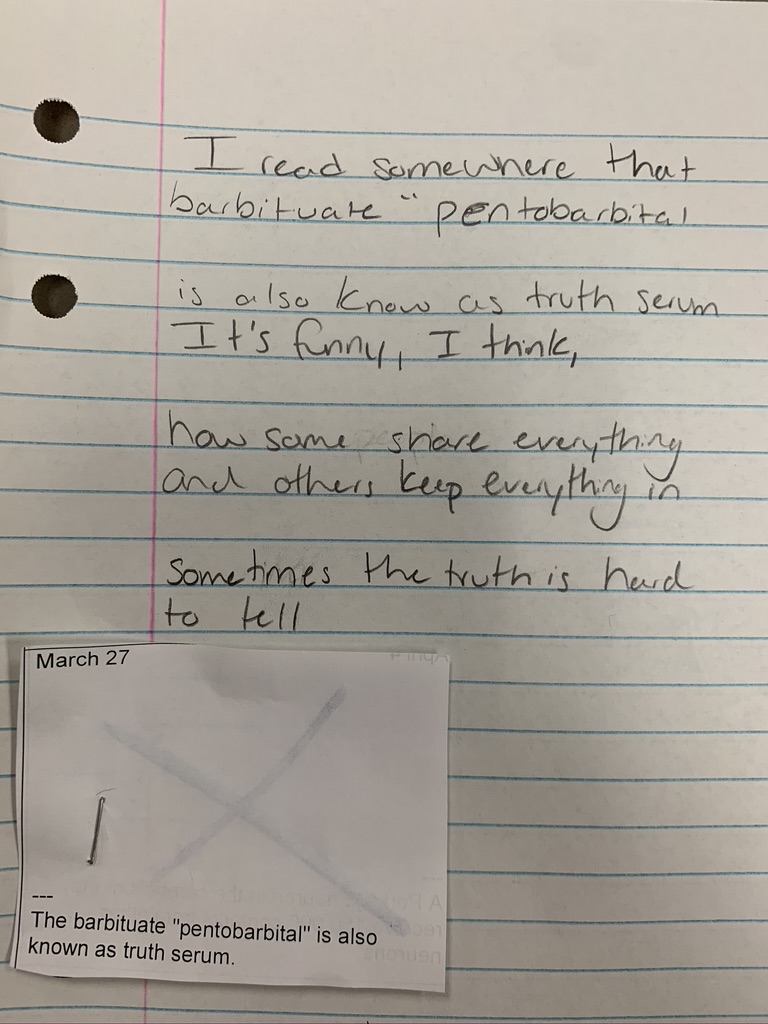
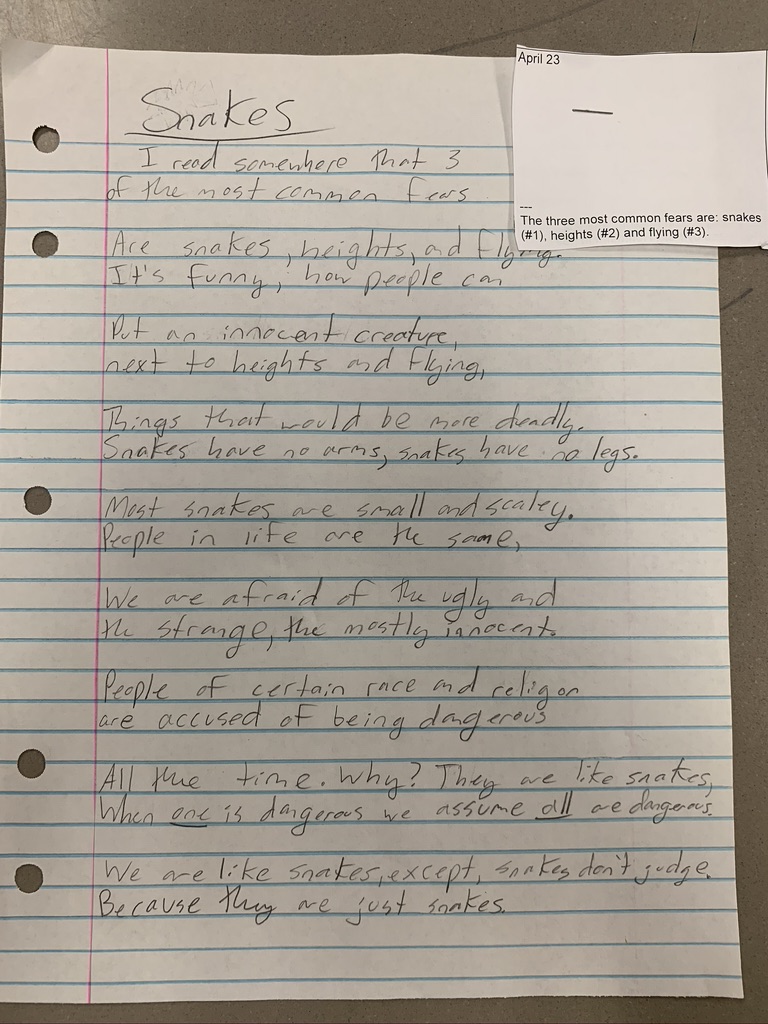
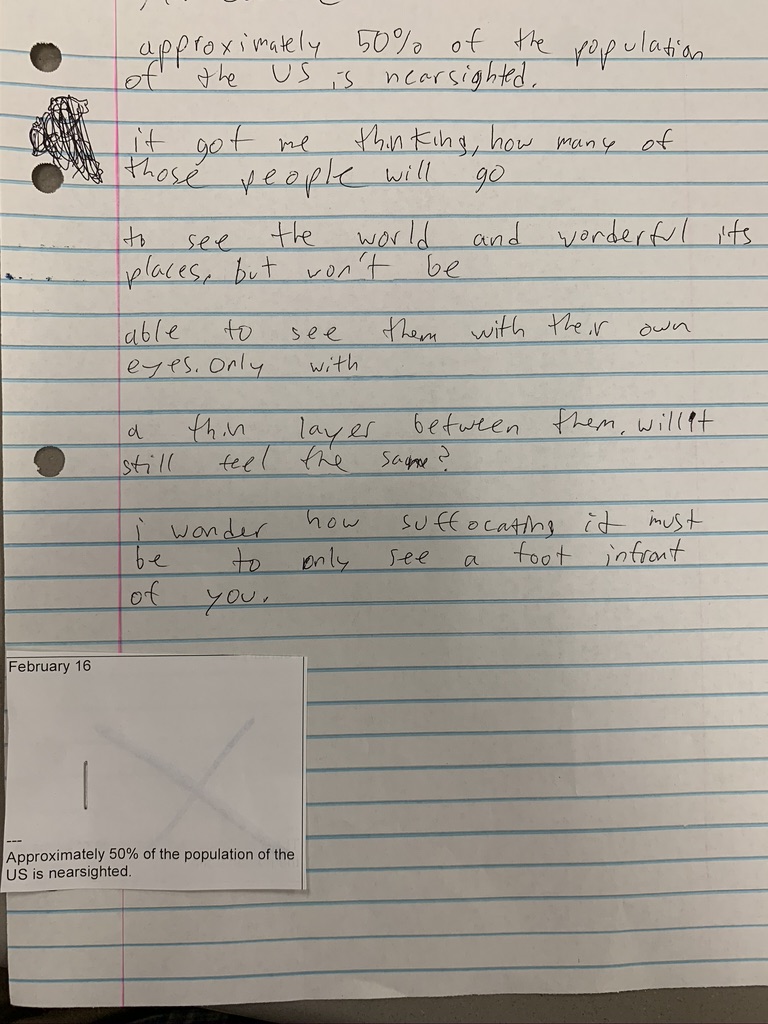
I distribute one of these cards or fun science facts to each student. But make sure to review them. Some are way better than the others. Some facts include ‘The barbituate "pentobarbital" is also known as truth serum.’ & ‘The term "homo sapiens" comes from the Latin words meaning "wise man."’ 


After reading the poem aloud and discussing it the students then use their science fact to create their own poem on how the fact relates to life. Check out some of these facts below with the accompanying student-generated poems. The one entitled Snakes was incredibly powerful!


Further Reading:


Cayne Letizia teaches 7th and 8th Grade English in a town just outside of NYC. This is his 20th year as an educator. He is passionate about literacy and social justice. You can follow him on Twitter here: @cayneletizia

Tuesday, March 17, 2020

2020 Post #3 -- Sarah Kay and the Power of Lists

by Candace Brobst

Sarah Kay has the power to convince even the most jaded students among us that poetry isn’t so bad. She is both poet and hypnotist, and April is a time when teachers are perhaps more in need of the latter. To be honest, there are days in April where T.S. Eliot’s “The Waste Land” doesn’t seem so bad.


I teach Seniors, by choice I might add, not because my school’s administration is trying to punish me. And by April, student engagement is waning. Seniors have grabbed the nearest scissors, and they are cutting their own umbilical cords to anything school related. Younger students are no doubt also feeling the restlessness of spring, the home stretch, whatever. I like to capture that I-have-something-to-say-before-I-go energy with Sarah Kay’s “If I Should Have a Daughter…” TED Talk.


The entire TED Talk (18 minutes) is a you-can-do-this tutorial and inspiration for writing performance poetry so if you have a whole period, keep going. Have students become the virtual participants in Kay’s master class. There’s even another great poem at the end.


But if time is short, and you are trying to follow Brett’s lead with this poem-a-day challenge, just play the poem (the first three and a half minutes of the TED Talk). Kay assumes the role of an imaginary mother giving advice to her imaginary daughter. In the spirit of the poem, direct students to become the sages (a.k.a. mothers 😉). Have them create a quick list, as in: “Things I Know to be True” or “I Wish I had Known…” From there, Pair-Share, throw ideas on the whiteboard, or make a Nearpod Collaborate! Board.


Seniors in particular can do this as a culminating reflection on high school. Start with a list they can ultimately use to write letters to younger versions of themselves, armed with what they now know… things like: “Don’t wait until Senior year to take that first art elective” or “Audition for the musical; you are going to meet your best friends.” One year, my school (graduating class around 1000 students) had Seniors write letters of advice to incoming Freshmen. Distributing them was a logistical nightmare (one we never repeated), but it may work better in smaller districts.  

Further Reading:


Candace Brobst (brobstc@parklandsd.org) teaches English and Creative Writing at Parkland High School in Allentown, PA. She very much enjoys receiving assignments from former students.


Postscript: OK, OK, this is Brett writing now and I need to explain the last line of that bio . . . Candace Brobst is my high school creative writing teacher and one of the MAJOR early influences. My love of reading and writing poetry owes so much to this wonderful teacher, and I feel so honored that she agreed to write a post to my blog project.

Monday, March 16, 2020

2020 Post #2 -- A Participatory Poem

by Brett Vogelsinger

It is rare to find a poem for my Poem of the Day routine that barely requires any forethought about what aspect to admire, discuss, or interrogate as a class, but "The Alley Violinist" by Robert Lax is one such poem.

The poem concludes with a choice for the reader:

"Would you:
stand there and play?

Beat it?

Walk away playing your fiddle?"

This rare, multiple-choice closing chord allows us, the readers, to look inside at what we value and to wrestle with competing priorities in a situation none of us have personally faced.  There is something deliciously riddle-like about this short poem.

So invite students to share which choice they would make and why.  Students tend to enjoy defending their choice, and they pull textual evidence!

After years of sharing this poem with students, I have also noticed that no one usually chooses the final option.  If the same happens in your classroom, pose the question: Why is this option so undesirable?  What might this reveal about human nature?  When is compromise valuable, and when is it unwelcome?

Further Reading:


Brett Vogelsinger is a ninth grade English teacher and NBCT at Holicong Middle School in Doylestown, PA. He is the founding editor of Go Poems, facilitates his school's literary magazine, Sevenatenineand contributes monthly posts at Moving Writers. You can follow him on Twitter @theVogelman.

Sunday, March 15, 2020

2020 Post #1 -- What Is Worth a Swerve?

by Ken Bui

We know that poetry can be a wonderful way to provide students with the opportunity to truly think and dive into meaningful conversations. Some of the most meaningful conversations stem from poems that challenge students’ values and really ask them to reflect on what they feel, what they believe, and why that is. One poem that fully allows for this opportunity is William Stafford’s “Traveling through the Dark,”an iconic, short poem that captures a raw moment of moral dilemma.

By the end of the poem, following hesitation and self-mediation, we see the speaker make a decision, “my only swerving,” and are left with a chance to react and evaluate.

Optimally, I have found that this poem works well as a great whole group read-aloud, breaking it up into stanzas with multiple voices pulling us through the suspense. Often, I hear some students gasp to themselves when the reality of the final couplet settles in.

Challenge students to talk about the pros and cons of the speaker’s actions. It can be interesting to ask students if they agree with the speaker’s choice, or, conversely, what realistic action they would have personally taken.

Discuss the qualities of moments in life that make us “hesitate” and push us to “hear the wilderness” or the world around us “listen.”

Dig into the depth of that last couplet: “I thought hard for us all -- my only swerving.” It’s a splendid springboard for conversation. Invite students to think about how we “think hard,” make difficult decisions, and “swerve” in our own lives – as a society and as individuals. As humans, why do we swerve? What is worth swerving for?  

Further Reading:


Ken Bui is a former English teacher and administrator in the North Penn School District. 

Monday, April 8, 2019

2019 Post #25 -- Make Your Peace

by Brett Vogelsinger

Anna Grossnickle Hines is a poet who brings a beautiful blend of poetry and quilting expertise to her books for children.  Since I am a poetry enthusiast, and my wife is a professional embroidery artist, we were thrilled to discover her picture books this year!

Her 2011 picture book, Peaceful Pieces, contains a poem that will speak to younger and older writers alike.  It is called "Peace: A Recipe," and the picture under the poem shows how the quilting complements the words.


Peace: A Recipe

Open minds -- at least two.
Willing hearts -- the same.
Rinse well with compassion.
Stir in a fair amount of trust.
Season with forgiveness.
Simmer in a sauce of respect.
A dash of humor brightens the flavor.

Best served with hope.
Click to Enlarge!

After reading the poem twice aloud in my classroom -- first a teacher reading, then a student read aloud -- I ask my students to think of someone that they need to make greater peace with in their own lives.  I invite them to ponder: which of the "ingredients" in this poem could help lead to greater peace.  In their Writer's Notebooks, write for a few minutes about what action they could take using this "ingredient" to create greater peace in their relationship.

This activity welcomes students to see poetry not just as literature or a collection of images or a weaving of words.  Of course, it is all these things.  But it can also be a motivator, a catalyst for change, an invitation to an epiphany.

As teachers, we cannot manufacture epiphanies.  But we can give students the chance to take a message from a poem and look for ways to apply it in their lives.  This deceptively simple poem may give them just such a chance.

Further Reading:


Brett Vogelsinger is a ninth-grade English teacher at Holicong Middle School in Bucks County, PA.  He has been starting class with a poem each day for the past ten years. He is the creator of the Go Poems blog and the author of Poetry Pauses: Teaching With Poems to Elevate Writing in All Genres.   Find him on Twitter @theVogelman.


Wednesday, March 20, 2019

2019 Post #6 -- A Poem in a Picture Book

by Brett Vogelsinger

Former Poet Laureate of the United States, Juan Filipe Herrera, shares his memoir in the poem-as-a-picture-book entitled "Imagine."

The book is beautifully written and illustrated, weaving some Spanish words into the English poem as it follows Herrara's trajectory as a child of migrant workers to his first experiences learning English to his post as Poet Laureate.  It concludes with the words "Imagine what you could do."

I tell my ninth-grade students that for today's Poem of the Day we are going to have an elementary school library class experience, and I ask them to gather around.  Some of them choose to sit on the floor just like they did for "carpet time" back in elementary school.  Nostalgia for this kind of reading runs deep and strong.

I make sure every student gets to ponder each page, reading it slower than most poems, for the format breaks it up into illustrated pieces we want to savor.

The last line, "Imagine what you could do," has landscape illustration paired with it that hearkens back to Herrera's youth.

In their Writer's Notebooks, students might take that same line and illustrate it in a way that inspires them and relates to either their early life or to their future goals and what they would like to accomplish.


Further Reading:


Brett Vogelsinger is a ninth-grade English teacher at Holicong Middle School in Bucks County, PA.  He has been starting class with a poem each day for the past six years and is the creator of the Go Poems blog to share poetry reading and writing ideas with teachers around the world. Find him on Twitter @theVogelman.

Tuesday, March 19, 2019

2019 Post #5 -- Snow Day Revolution

by Brett Vogelsinger

If you live in a region that gets the occasional snow day, you know how exciting they can be for students and teachers alike. Snow days offer an unexpected period of found time, the opportunity to slow down, push back a deadline, and catch your breath.

Billy Collins' poem "Snow Day" captures how it feels to be a "willing prisoner" to the snow. I love to share this poem with my students when we return from a snow day.  After our first reading, I ask students to keep an eye on something during our second read.

Collins mentions "a revolution of snow" in his poem.  Where do we see the language of revolution threaded through this poem?  How does he subtly build on this idea elsewhere with his imagery and diction?  Like tracking animal footprints into the woods, students enjoy the challenge of following the words that suggest revolution: white flag, government buildings smothered, anarchic cause, a riot afoot, a queen about to fall.

I should mention here that Billy Collins' exceptional Poetry 180 project advocates sharing poetry without much commentary or analysis at all, and this poem is ideal to share in that way as well.  It is the perfect invitation back to school after the welcome but unexpected interruption of a snowstorm.  And everyone loves that list of nursery school names at the end!


Further Reading:


Brett Vogelsinger is a ninth-grade English teacher at Holicong Middle School in Bucks County, PA.  He has been starting class with a poem each day for the past six years and is the creator of the Go Poems blog to share poetry reading and writing ideas with teachers around the world. Find him on Twitter @theVogelman.

Friday, April 6, 2018

2018 Poem #23 -- All Things Big and Small

by Zachary Sibel

In the world of spoken word poetry, it is hard to beat the work of Rudy Fancisco. His work is powerful, brilliant, and highly entertaining. While his videos are incredible -- and I suggest you use as many as you can -- his recently published anthology, Helium, presents a number of written texts that fit well as a warm-up in any class.

One text that I have used recently is a poem he first published via social media and later used in his book.


Find this poem in Rudy Fransisco's book, Helium, or in the original tweet.  

This poem is simple and presents an abundance of opportunities to talk about language and narrative.

Before introducing this poem, I talk to students about some fears that I have, things like flying and heights. I ask students if they have any fears and discuss whether they are rational or not. I end the brief discussion with what seems to be a surprising statement for some students: that I am terrified of spiders. I then show them this poem on my screen. I read the poem aloud and ask for a student reading.

The discussion can go a number of ways. Focus on the first half: "How does the poet react when asked to kill a spider, a task we all have probably done without giving it much thought?” Or focus on the second half of the poem: “What profound statement is made about the refusal of a simple task, killing a spider”.

I start with these questions but also allow student to just talk about the poem and what they got out of it. I close the discussion with the fact that since reading this poem a year ago, I haven’t killed a spider. Because of the way Fancisco addresses the idea of being “caught in the wrong place/at the wrong time, just being alive” I have tried to treat all things with a greater sense of kindness and mercy. Poetry can change us.

A suggested pairing: Read this text alongside William Blake's "The Fly"  and allow students to analyze “How does poetry allow us to see large concepts in the smallest of creatures?”

Further Reading:


Zachary Sibel is a hip-hop fan and an eighth-grade English teacher at Tohickon Middle School in Bucks County, PA. 

Tuesday, March 28, 2017

Go Poem #14 -- Mythological Allusion

by Elizabeth Howlett

Students read the poem "Demeter’s Prayer to Hades" by Rita Dove silently as it is projected on the screen. Every time I present a poem to my students I explain that poetry is written to be heard, that the ear may pick up on what the eyes do not. Therefore, the second read is my vocal interpretation of this poem’s tone and fervor. Whether you do or do not know the story of Demeter, how does the speaker’s tone strike you?

As a poem about mythology, the first quest is to ferret out all of the mythological allusions. Who are Demeter and Hades? What is the nature of their relationship? Consider presentation of the myth as a paired text.

What if we take the mythology out of it? Is this not a mortal scenario?

If someone has wronged us, don’t we wish that they could have “knowledge” of the impact they have had?

Still, the poem does speak of both gods and mortals. Being a deity in mythology does not mean you are without flaws, and worshipping the gods means believing in those who are subject to the
weaknesses of man.

What are the consequences for anyone who attempts to “play god?"

This poem invites rich discussion and deep thinking about our own lives and the power of allusion.


Elizabeth Howlett is a seventh grade ELA teacher in San Antonio, Texas.


Further Reading

Wednesday, March 22, 2017

Go Poem #8 -- A Poem in Two Languages

by Brett Vogelsinger

I must confess, I am a little partial to the poem "Revenge" by Taha Muhammad Ali because I was present for its English-language debut at the Dodge Poetry Festival in 2006.  To hear a poem spoken first in Arabic, meaningless to a primarily English-speaking audience, reminded me first of the marvels of language; what is without meaning to one person is deeply, profoundly impactful to another.  And when I heard this poem repeated, the second time in English, the power of Ali's words brought the entire audience to our feet, for here was a poem entitled "Revenge," crafted in one of the most conflict-striken regions of the world, that is actually about the power of choosing peace.


If you choose to share this entire video of the poem with your students, it will take a little more time than some of our Go Poem activities, but I think you will find it to be worth it.  I share photocopies of the poem with my students, turned face-down until after the video has finished playing.


Part of what makes this poem so impactful is its structure.  What we may refer to as a "plot twist" in a novel or a movie we refer to as a "turn" in a poem.  Where does this poem take a surprising turn?  What is the nature of that turn?  By surprising us with these unforeseen turns, what do you think the poet wants us to leave the poem thinking about, wondering about, or believing?  (That last question digs at the question of theme, but isn't it so much more interesting than asking "What is the theme of this poem?")


Brett Vogelsinger teaches freshman English students at Holicong Middle School in Doylestown, PA where he starts class with a poem each day. Follow his work on Twitter @theVogelman.


Further Reading