Showing posts with label imagery. Show all posts

Tuesday, March 15, 2022

2022 Post #1 -- The Magic of Ordinary Moments

by Allison Marchetti

Two years ago, I suggested the poem “The Return” by Jonathan Greene, for helping our students think about the grounding and comforting nature of rituals in times of upheaval.

This year, I offer “Abundance,” which contains a similar invitation. In this poem, Amy Schmidt argues that simple, everyday acts can evaporate loneliness and lead us to discover the bounty in our lives. I just can’t get enough of poems that zoom in on the magic of daily routines and ordinary moments. Plus, Schmidt dedicates this poem to Mary Oliver, one of my most cherished poets.

Here’s what working with this poem in your classroom might look like:


1. Read the poem out loud.

2. Discuss what you notice about the poem. Here are a few things that might come up, or that you might draw their attention to:

  • The title is an abstract noun, followed by a concrete description.
  • The poem consists of five very short sentences.
  • The poem is directed at a “you” and contains commands (scrape, look).
  • In one short sentence the poem illuminates how the simple act of zesting an orange can lead to noticing abundance: “Scrape…and the whole room fills…”
  • "S" sounds
  • Use of colon and fragments (“Always have”)

3. Then, encourage students to share everyday acts that could illuminate the big feelings we have. Could brushing our teeth somehow remind us to laugh? Wiping down the countertops bring a moment of clarity? How could some of the mundane acts of our lives inspire happiness, lightness, togetherness, courage – any number of positive feelings?

4. Finally, invite your students to write beside this poem, perhaps borrowing the frame:


It’s impossible to be ______________

when…


Look around: you

____________________________


You just didn’t notice

until now.


Further Reading: 


Allison Marchetti is co-author with Rebekah O’Dell of WRITING WITH MENTORS, BEYOND LITERARY ANALYSIS, and A TEACHER’S GUIDE TO MENTOR TEXTS (Heineman). She is the co-founder of Moving Writers, a blog for secondary writing teachers. She lives with her family in Richmond, Virginia.

Sunday, April 11, 2021

2021 Post #28 -- Musings On Mother's Hands


by Nawal Qarooni 

A creator’s ability to hone in on one object, item or body part and describe its weight, meaning and importance is a skill that student writers, too, can replicate in their craft. It’s one that can lead to homages and odes, broadening gratitude for things that might go unnoticed without a keen writer’s eye. In its simplest form, it can lead to emotional musings about individualized objects that beg for reflection.

Nate Marshall, in his poem titled "my mother’s hands" from his latest poetry book, Finna, brings alive descriptions of hands as a salve in hardship, outlining childhood memories in a small slice of time.

In the classroom, we might share this poem and ask students:
  • How does his mother’s hands care for him?
  • What message does he glean from his mother’s massage?
  • How does he use repetition in the poem?
Once students have had time to digest and discuss the poem, we might ask them to generate their own lists of items, objects or body parts that are especially meaningful, and carry emotion or story. When I feel stuck generating ideas, I close my eyes and recall moments where I cried or felt like screaming; where I was worried or scared. In a simple T-chart, model brainstorming like this aloud.

For example, I would include:

my daughter’s slim wrists → carries emotions about my last daughter.
my grandmother’s headscarf → flashbacks to memories of her laughter and everyday smiles.
my father’s handlebar mustache→ and how it represents, for me, what he wanted but didn’t achieve in life.

These body and item connections evoke strong emotion and memory that support the creation of poetry similar to Nate Marshall’s. Once students brainstorm lists, set a timer and ask that they try their hand at a poem- perhaps weaving in repetition, perhaps never sharing it. I leave it up to students whether or not they choose to share. Yes, there’s power in having an audience and writers are fueled by feedback but at the same time, some writing is personal, cathartic, and for the creator alone.


Further reading:


Nawal Qarooni is an educator, writer and literacy coach based out of Chicago, IL. She designs learning experiences alongside teachers and is mother to four multilingual, multiethnic kids, who very much shape the way she understands learning. You can read more about her work at NQCLiteracy.com and follow her on Twitter @NQCLiteracy.

Friday, April 9, 2021

2021 Post #26 -- A Phone-Scroll Self-Portrait

 by Brett Vogelsinger

Every teenager -- and most adults -- can be seen in their native habitats scrolling through their phones sometimes.  While the term "doomscrolling" has emerged as an etymological outcropping of our lives over the past year, there can also be a pleasanter sort of scroll to try on your phone. Wandering through photos of better times you have almost forgotten about can bring a sense of warmth to a cold and lonely season. 

Jonathan Potter's poem, "Self-Portrait with Wife" is an excellent example of the power words have when they are inspired by and create images.  

Potter's poem seems simple enough, at first, a list of the details of an image of two people with photographic accuracy.  But the words used to capture these images are powerfully suggestive of backstory and plot: "our bed of bliss," "the laundry basket empty," "your son's painting" and "the almost hidden books." What do each of these snippets suggest about these characters?  What do they show but never tell us about the people in the portrait? 

Challenge students to scroll through their own phone and find a "self-portrait" with another person.  Capture the details in the photo with words, even the unintended details of the background, clothing, positioning, and light.  Suggest some of the history of these two people without telling the reader about them.  What might their footwear (or lack of it) imply, like it does in the poem we just read?  What fragment of a story do the surroundings of these people tell, like that smudge on the mirror in Jonathan Potter's poem? Has anything been cropped from this photo, and what might this suggest to a reader, if we let them in on that secret? 

Every developing artist creates a self-portrait at some point.  Developing poets can too.  Make it a self-portrait with a second person, and possible plots emerge at the edges.  

Further Reading:

Brett Vogelsinger is a ninth grade English teacher and NBCT at Holicong Middle School in Doylestown, PA. He is the founding editor of Go Poems, facilitates his school's literary magazine, Sevenatenineand contributes monthly posts at Moving Writers. Follow him on Twitter @theVogelman.

Monday, March 22, 2021

2021 Post #8 -- Reflections of Hope in "My Mother's Eyes"

by Andrew Schoenborn

Looking into a mirror or even catching a glimpse of yourself in a darkened window allows you to see yourself objectively and, depending on the circumstance, subjectively. The image we see can be practical, if we are grooming our hair, or produce an emotional response, if we find ourselves looking inward. What visions, emotions, experiences, hopes, and dreams, however, might emerge from the reflections of ourselves we find in the eyes of another? What do they see in us that we may not see in ourselves? How might hope spring from those reflections?

Today let’s ask students to listen to the words of the Chilean-American author Marjorie Agosín. In her poem “My Mother’s Eyes,” Agosín shares the hope she sees for herself in the reflections of her mother’s eyes.

Marjorie Agosín begins her poem: “My Mother’s Eyes”:

My mother's eyes
are cities
where birds
nest
where voyages of the ill-fated
come to rest
where water is a mirror
of sung secrets.

Explore the places these eyes have seen and the unique qualities held in the eyes. Use those moments to shed light on lessons learned as well as adversity they have overcome. Seek, in those perceptions, the qualities you admire that are transmitted and, therefore, reflected back to you.

A writer’s composition is strengthened by the intentional choices made and the effect of those choices on a reader. As a composer of images and words, a writer is in control and powerful pieces are crafted when the author reveals their unique (and sometimes unexpected) perspective that seeks to uplift oneself and others.

Process:

Read “My Mother’s Eyes” and welcome her words into the classroom to set the tone for inspiration and let Marjorie Agosín lead the way. Like Agosín, ask students to begin their poem with “My mother’s eyes…” and see where you end up.

What do you think they see? What do you see when you look at her?

Or, change out the person: “My friend’s eyes…,” “My grandfather’s eyes…,” “My significant other’s eyes…,” etc. Choose the eyes that inspire hope, peace, grace, joy, or a sense of belonging for you.


Sample poem:
“My Grandmother’s Eyes (Inspired by Marjorie Agosín)” by Andy Schoenborn


Photo by Andy Schoenborn

I

My grandmother's eyes
are rolling pastures
where roots
grip tradition
where neighbors weary of work
come to rest
where the good earth is keeper
of whispered words.

II

My grandmother's eyes
are rolling pastures
of coarse corn
strengthening the grip
of a calloused hand.
I approach them
and on the threshold of her eyes
a boy is looking
for himself in the clear blue skies,
in soft sands of insecurity.

In my grandmother's eyes
I also encounter myself
because into them
I move,
to find the steady rhythm of peace
and love
in rolling pastures endured, with humility, for me.


Reflecting on the Strategy:

From time-to-time students may be asked to reflect on their thoughts, actions, and deeds. It is challenging sometimes to reflect upon oneself and see the goodness that lives inside. However, when asked to reflect on the qualities a loved one sees in us, students are invited to encounter and embrace positive self-talk.

This poetry writing strategy creates a win-win-win in the classroom. Students win because they are encouraged to visualize themselves in positive and purposeful ways. Teachers win because they are able to share pieces of themselves while modeling vulnerability. And, poetry wins because words will be viewed through a new lens that encourages the sharing of personal perspective through poetry.

Further Reading:


Andy Schoenborn is an award-winning author and high school English teacher in Michigan at Mt. Pleasant Public Schools. He is a past-president of the Michigan Council of Teachers of English, teacher consultant for the Chippewa River Writing Project, and Region Rep for the Michigan Reading Association. His first book, co-authored with Dr. Troy Hicks, Creating Confident Writers was published in 2020. Follow him on Twitter @aschoenborn.

Friday, March 19, 2021

2021 Post #5 -- Kaleidoscopic Thought

 by Brett Vogelsinger

Since childhood, I have always loved the mirrored, sparkling, shifting imagery a kaleidoscope can offer. For this mini-lesson, it might be fun to have this YouTube video of hypnotic, kaleidoscopic imagery projected on a screen as students enter the classroom:


The poem "Thought." by Alice Dunbar-Nelson was recently featured by the Academy of American Poets in their Poem-a-Day emails, a subscription I highly recommend.  

It goes like this: 

Thought. 

A swift, successive chain of things,
That flash, kaleidoscope-like, now in, now out, 
Now straight, now eddying in wild rings, 
No order, neither law, compels their moves,
But endless, constant, always swiftly roves. 

The poet catches my eye when she says thoughts are "kaleidoscope-like," and in keeping with this simile, continues to shift from comparison to comparison, image to image for the remainder of the short poem. Reading the poem makes me pause and tune into my own stream of consciousness, that subtext to our experience in any moment that often escapes our notice. 

After reading the poem, I might ask the class to comment on "What does Alice Dunbar-Nelson observe about human thought? How does the way our thought patterns work relate to those kaleidoscope patterns we were watching on the screen a moment ago?"

Next, we could pause for sixty silent seconds with this aim: Just tune into the kaleidoscope of your own thoughts. In the course of sixty seconds, where does your mind go. What shifts happen and what forms emerge? 

Then, in our writer's notebooks, we can craft a short poem that tries to put those shifting thoughts into words. Remember, it could be figurative instead of literal, and it doesn't have to make pure, perfect grammatical sense, much like Dunbar-Nelson's poem. 

Georgia Heard's new book of children's poems, My Thoughts Are Clouds: Poems For Mindfulness, helps readers to do what this lesson emphasizes, pausing in the moment to bring awareness to just what is going on in our mind. In stressful times, teaching students how to do this, then putting some of their thought into words that will not be judged, assessed, or graded, can serve an important emotional purpose in our classroom. This kind of pause can provide a balm in anxious or divisive times.  

And our students do well to remember that whoever they are and whatever their aspirations, their thought is "endless, constant, always swiftly roves."  

Further Reading


Brett Vogelsinger is a ninth-grade English teacher at Holicong Middle School in Bucks County, PA.  He has been starting class with a poem each day for the past ten years. He is the creator of the Go Poems blog and the author of Poetry Pauses: Teaching With Poems to Elevate Writing in All Genres.   Find him on Twitter @theVogelman.


Monday, March 15, 2021

2021 Post #1 -- Small Moments

by Linda Rief

So many of our students believe that their lives are so uninteresting that there is nothing to write about. But so often, those small moments are some of the most important moments. Kaylie, one of my former eighth graders, shows us just how special a certain moment is when she describes a night walk with her dad.

Read Kaylie’s poem “Night Walks” out loud to your students while they have copies in front of them. Tell them you will read it a second time and ask them to underline any phrase or line that feels important or holds significance for them.

Night Walks
by Kaylie M. (8th grade)

When I was little
The sky danced with new stars
My dad bundled me up
And took me out for night walks


Cradled in his arms
He pointed out the Big Dipper
The Little Dipper
The North Star
Beetlejuice

I don’t remember the story of Beetlejuice
But I remember it was significant
Because my dad pointed it out to me
Beetlejuice is yellow
Far away from Earth

And I know that the older you get
The more distant you become
Farther and farther away from those
Who captured you in their warm embrace
Never reluctant to offer comfort
When it was needed most

The stars
Glistened in the bright sky
Elegant
Full of life’s greatest secrets

Cradled in his arms
Protected by his warm embrace
His breath cool against my cheek
We watched the stars spin
Above the earth and life as we knew it


After reading the poem twice, and underlining any lines or phrases, you can try this:

Write out anything Kaylie’s poem brings to mind for you.

Borrow any line that you underlined and write as fast as you can for two to three minutes, letting the line lead your thinking.

Think about the “small moments” that might have happened while you have been “sheltering-in-place” at home: Write as fast as you can for three to five minutes to capture the essence of that moment.

After finishing this first draft writing, go back to see if there is some line or phrase you want to slow down and develop. Write more. Or simply take some time to extend what you said in only two to five minutes.


Further Reading: 


Linda is an instructor in the University of New Hampshire's Summer Literacy Institute and a national and international presenter on issues of adolescent literacy. She is the author of The Quickwrite Handbook, Read Write Teach, Inside the Writer's-Reader's Notebook and forthcoming from Heinemann Heartfelt Transitions: Using Poetry to Inspire & Deepen Reading & Writing. In 2020 she received the Kent Williamson Exemplary Leader Award from the Conference on English Leadership, in recognition of outstanding leadership in the English Language Arts. Twitter handle is @LindaMRief.

Friday, April 10, 2020

2020 Post #27 -- The Stories of Tattoos

by Brett Vogelsinger

One of my favorite poets I have discovered in the past few months is Ariel Fransisco.  I've shared several of his poems with my classes, but one short piece that provokes some great conversation and writing is "Poem Written in the Parking Lot of a Tattoo Shop While Waiting For an Appointment."  Sometimes when sharing a poem that is brand new to me for our Poem of the Day routine, is simply put the question to students:  What do you notice?  What should we talk about in this poem?

They are experienced readers of poetry by this point in the year, and invariably they find something I missed in my own reading of a poem.

In this poem, we end up talking about the speaker.  Is this the speaker's first tattoo?  Why is he getting one?  Will he go through with it? The line "I'm in search of any kind of permanence" becomes central to our conversation.

I ask students "How many of you will likely get a tattoo someday?  How many of you think you never will?  Why? And why are tattoos so popular right now?"  This could be a conversation or a writing prompt, but in the course of talking as a class, students began to tell stories of family members and their reasons for getting tattoos, some of which opened my eyes to people's quest for "permanence," often using tattoos to record a painful loss or deep devotion.  These personal stories  looped us back to talking about the speaker in the poem again.

Further Reading (out 4/21/20):


Brett Vogelsinger is a ninth-grade English teacher at Holicong Middle School in Bucks County, PA.  He has been starting class with a poem each day for the past ten years. He is the creator of the Go Poems blog and the author of Poetry Pauses: Teaching With Poems to Elevate Writing in All Genres.   Find him on Twitter @theVogelman.


Monday, March 30, 2020

2020 Post #16 -- Star Dust

by Rama Janamanchi

This year on Valentine’s Day, NASA celebrated the anniversary of one of our most famous self-portraits and I found myself falling in love again with the Voyager photo of the ‘pale blue dot.’ I am reminded each time I see the image of the feeling of being awestruck. I felt similar awe when I held my children right after they were born. I was filled with wonder at the possibilities they embodied even as I was humbled by their fragility. Ada Limon’s poem, “Dead Stars,” reminds me forcefully that we need to create space in our routine for those moments of awe. It is too easy for us to forget the extraordinary panorama against which we lead our mundane lives. 


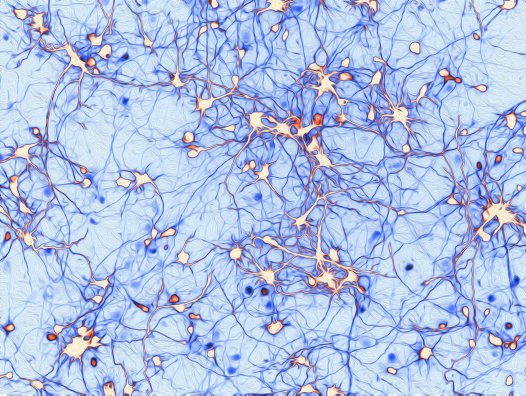
Before the kids come into the room, I place these images in different parts of the room. Two are from NASA’s Hubble Telescope and two are of neurons firing. 


We read Ada Limon’s poem - silently, then chorally. 


Students walk up to the images and write down a brief description of each image. Then they walk around again and this time they add emotions to their description. We talk about the similarities between images of the brain and the Hubble images. We list the similarities in how they look and how they make us feel. We talk about how the feeling of discovery when we recognize our connections to the stars. 


We read the poem again. Students read silently, then chorally. We highlight moments of discovery in the poem. We write down our own rediscoveries of the ordinary.

Further Reading:


Rama Janamanchi teaches at a private high school for students with language-based learning differences. Twitter: @MsJanamanchi410 


Tuesday, March 24, 2020

2020 Post #10 -- Trapped

by Nate Harris

During my first week teaching 9th grade English Language Arts, I gave my students what I thought was a simple writing diagnostic to complete, which asked them to do the following: Write about a time in your life when you felt trapped. You may write about being trapped physically or being trapped in some other sense, perhaps socially or emotionally.

After a few minutes of silent writing, one of my two English Language Learners, a 13-year-old girl from Russia, raised her hand. She proceeded to shyly ask me what the word “trapped” meant, and I did my best to give her a personal definition, followed by several examples. Not two minutes later, the same scenario played out with my other ELL student, a girl from Spain.

It was this scenario that inspired me to use Paul Laurence Dunbar’s poem "Sympathy" to introduce the concept of feeling trapped and review the poetic elements of rhyme scheme, end rhyme, and imagery.

As the year progressed, I also connected the poem to the themes of oppression and the power of empathy and sympathy that appear throughout my curriculum in texts such as To Kill a Mockingbird and Night. In order to fully make these connections, it is important to note (while introducing the poem) that Dunbar’s parents were born slaves, and so his voice as an observer of the oppressed and formerly oppressed is authentic and credible.

Further Reading:


Nate Harris is in his sixth year of teaching English Language Arts, and is excited and humbled to be a part of a collection of inspirational ideas. He has not had any social media since his senior year of college, but he can be reached at nharris@cbsd.org.

Sunday, April 7, 2019

2019 Post #24 -- Reading and Writing Outdoors

by Sarah Mulhern Gross

Mary Oliver’s “The Summer Day” is one of my favorite poems to share with students. It’s one of Oliver’s best-known and most-quoted poems and has been included in a few of her anthologies. It strikes a chord with many high school students as they are beginning to think about their lives beyond high school. It’s also a great way to get students to slow down and observe nature for a few minutes.

Begin by giving students a copy of the poem and let them read along as they listen to Mary Oliver read it. I like to take my students outside for this activity, so I use my cell phone to share the audio. Ask your students to mark the phrases or lines that strike them in any way while they read the poem. After students have read the poem and listened to Oliver read it, have a brief discussion. I always point out to students that “The Summer Day” sounds like a prayer to me, and this makes sense because Oliver frequently talked about how the forest was her church. Ask students what their “church” might be. Where do they feel spiritual? Where do they feel safe and at peace?

After a brief discussion, give students a few minutes to write. Ask them to let the sights and sounds of the outdoors guide their writing as they try to answer the question “What is it you plan to do with your one wild and precious life?” I don’t give my students too many guidelines here as I just want them to write. Their response can be in prose or poetry form, and if they really get stuck I encourage them to sketch.

You could easily extend this activity into a full lesson by having students choose something outside (a tree, a blade of grass, a bird, a bug, etc) and center their response around it like Oliver centers her poem around the grasshopper. They could spend 10-15 minutes making observations about what they see, hear, smell, feel and (maybe?) taste while observing their species of choice. Oliver’s poem can serve as a mentor for their response to the question in her final line.

For more on Mary Oliver, check out this excellent New Yorker piece: Mary Oliver Helped Us Stay Amazed

For a brief Go Poems idea for Mary Oliver's "Wild Geese" click here.

Further reading:


Sarah Gross is one of the co-organizers of NerdCampNJ. She teaches in central New Jersey and loves spending time outdoors.

Wednesday, March 20, 2019

2019 Post #6 -- A Poem in a Picture Book

by Brett Vogelsinger

Former Poet Laureate of the United States, Juan Filipe Herrera, shares his memoir in the poem-as-a-picture-book entitled "Imagine."

The book is beautifully written and illustrated, weaving some Spanish words into the English poem as it follows Herrara's trajectory as a child of migrant workers to his first experiences learning English to his post as Poet Laureate.  It concludes with the words "Imagine what you could do."

I tell my ninth-grade students that for today's Poem of the Day we are going to have an elementary school library class experience, and I ask them to gather around.  Some of them choose to sit on the floor just like they did for "carpet time" back in elementary school.  Nostalgia for this kind of reading runs deep and strong.

I make sure every student gets to ponder each page, reading it slower than most poems, for the format breaks it up into illustrated pieces we want to savor.

The last line, "Imagine what you could do," has landscape illustration paired with it that hearkens back to Herrera's youth.

In their Writer's Notebooks, students might take that same line and illustrate it in a way that inspires them and relates to either their early life or to their future goals and what they would like to accomplish.


Further Reading:


Brett Vogelsinger is a ninth-grade English teacher at Holicong Middle School in Bucks County, PA.  He has been starting class with a poem each day for the past six years and is the creator of the Go Poems blog to share poetry reading and writing ideas with teachers around the world. Find him on Twitter @theVogelman.

Tuesday, March 19, 2019

2019 Post #5 -- Snow Day Revolution

by Brett Vogelsinger

If you live in a region that gets the occasional snow day, you know how exciting they can be for students and teachers alike. Snow days offer an unexpected period of found time, the opportunity to slow down, push back a deadline, and catch your breath.

Billy Collins' poem "Snow Day" captures how it feels to be a "willing prisoner" to the snow. I love to share this poem with my students when we return from a snow day.  After our first reading, I ask students to keep an eye on something during our second read.

Collins mentions "a revolution of snow" in his poem.  Where do we see the language of revolution threaded through this poem?  How does he subtly build on this idea elsewhere with his imagery and diction?  Like tracking animal footprints into the woods, students enjoy the challenge of following the words that suggest revolution: white flag, government buildings smothered, anarchic cause, a riot afoot, a queen about to fall.

I should mention here that Billy Collins' exceptional Poetry 180 project advocates sharing poetry without much commentary or analysis at all, and this poem is ideal to share in that way as well.  It is the perfect invitation back to school after the welcome but unexpected interruption of a snowstorm.  And everyone loves that list of nursery school names at the end!


Further Reading:


Brett Vogelsinger is a ninth-grade English teacher at Holicong Middle School in Bucks County, PA.  He has been starting class with a poem each day for the past six years and is the creator of the Go Poems blog to share poetry reading and writing ideas with teachers around the world. Find him on Twitter @theVogelman.

Monday, March 18, 2019

2019 Post #4 -- An Ode to Food

by Joel Garza

I’m something of a romantic--that is, when it comes to poetry. I am drawn most quickly, most deeply to those poems that seem to be a recollection of a spontaneous and powerful experience, an overflow of emotions recorded artfully for a reader to taste. A poem, in these cases, happens to the poet and happens to the reader.


Here’s such a poem: “Ode to Cheese Fries” by José Olivarez. I think it’s an accessible and relatable and beautiful poem on its own. But if you’re interested in a full intellectual meal inspired by Olivarez’s poem, follow these steps.


Appetizer:
Ask your readers & writers to think carefully about one of their favorite things to eat. Start with the senses that surround and complement taste: What does it look like? What does it sound & smell like? How does its texture heighten its flavor? It’s okay to respond in single words--full sentences might come later, or they might not.


Now ask your readers & writers to look at what surrounds that food--take a look at yourself enjoying the food as if you’re above the action of you eating it. What setting do you associate this food with? (Your grandmother’s house, a local baseball stadium, a food court in a mall) Who is seated near you as you eat this delectable thing? What languages or decor or music provides the best foundation for your tastebuds? Finally, what’s the aftereffect / afterglow like that compels you to remember & return to this food?


First course:
It’s time to read the Olivarez poem. Ask your readers & writers to listen carefully while you read. Ask them to underline their favorite single feature of the poem--a word, a line, a turn of phrase, whatever. Read it out loud a second time, and have them say the underlined thing out loud with you. It’s really fun to see which lines pop for most readers, which images excite only certain folk.    


Main course:
Now it’s time for them to write their own ode. Congratulate them on all of the ingredients they’ve compiled in their prewriting: their reflections about senses and setting of their favorite food (the appetizer), their secret ingredient that excited them most about the first course (the Olivarez poem). The main course is their own dish cooked up their own way. ¡Buen provecho!

Further Reading:


Joel Garza is Upper School chair of the English department at Greenhill School. Here’s what he’s reading these days. Joel--in collaboration with Scott Bayer, Adrian Nester, & Melissa Smith--assembled this hyperdoc for #THEBOOKCHAT devoted to José Olivarez’s collection Citizen Illegal.

Monday, April 9, 2018

2018 Post #26 -- Take a Bite Out of Poetry

by Lauren Heimlich Foley

During a summer graduate class, I found myself re-inspired while participating in a poetry lesson modeled after Nancie Atwell’s writing-reading workshop. That afternoon, I dusted off Naming the World, making a promise to include more poetry the following school year.

Weeks later, I started a September class period with a poem by Ronald Wallace. To engage my students, I projected “You Can’t Write a Poem about McDonald’s” on the board and asked them what they thought.

Some groups, wanting to disprove the statement, created their own poems. Other tables believed McDonald’s was not an appropriate topic for a poem or would not make a strong writing piece. Still, others wondered if the clause was in fact a poem since quotation marks flanked both sides of it.

Once table groups shared their theories, I revealed that “You Can’t Write a Poem about McDonald’s” was indeed a poem. Students exclaimed phrases such as, “No way!” or “I told you so!” or “Really?” Intrigued by their enthusiasm, I wondered what their responses would be to the actual text.

After reading the poem and inviting students to share their highlighted lines, our room erupted with meaningful conversations. My nervous-unsure-second-week-of-school seventh graders transformed into investigators and analyzers. As I moved between groups, listening in on their discussions and asking questions to push their thoughts further, their commentary on diction, personification, imagery, similes, and symbolism led to dialogues on larger issues of consumerism, waste, world hunger, food accessibility, and the fast-food industry.

Additionally, we revisited “You Can’t Write a Poem about McDonald’s” during a later class period to discuss effective titles since my students’ initial reactions were so intense.

This poem’s ability to challenge my students’ beliefs of acceptable poetry topics while inviting them to take a platform through their own writing has made it one of my favorites.

Further Reading:


Lauren Heimlich Foley teaches seventh-grade English Language Arts at Holicong Middle School in Doylestown, PA.

Tuesday, April 3, 2018

2018 Poem #20 -- Pairing Poems

by Michelle Ambrosini

When I have paired a poem with another poem or with an image, my seventh grade students have shared prolific responses. Pairing “Always” and “Hope is the thing with feathers” allows students to enter the discussion of a big idea using both modern and classic text. By inviting students to sketch Dickinson’s “thing with feathers,” I ask students to make meaning through drawing as well as discussion.


Always


There will always be the waves
rushing in, tumbling out; 
the moon, the fog, the orange
of the morning sun. 
Sadness is not forever.
But let hope be. 


Let it sit by seaside towns,
drift among villages, 
wander in cities. Let it linger
in schools and shipyards
and factories. 


Let it call to you with the scent 
of cinnamon, the taste of mint,
the faraway chant, the chime 
of the clock.


There will always be the babble
of streams, birdsong, 
the whisper of wind. 
Sadness is not forever. 
But let hope be. 


Rebecca Kai Dotlich


Hope is the thing with feathers

Hope is the thing with feathers -
That perches in the soul -
And sings the tune without the words -
And never stops - at all -

And sweetest - in the Gale - is heard -
And sore must be the storm -
That could abash the little Bird
That kept so many warm -

I’ve heard it in the chillest land -
And on the strangest Sea -
Yet - never - in Extremity,
It asked a crumb - of me.

Emily Dickinson

First, students read aloud “Always” by Rebecca Kai Dotlich in pairs -- alternating stanzas or one as the first reader. (I have not yet shared Emily Dickinson’s poem “Hope is the thing with feathers”.) The first question I ask is “What do you notice?”

Students turn and talk and then we share our observations as a whole group.

Students notice the poet’s use of repetition of words: the first and fourth stanzas end with “Sadness is not forever. But let hope be.” They notice the pattern the poet employs in various lines. “There will always be …” starts the first and fourth stanzas. “Let it …” is repeated in the second and third stanzas. Another pattern students notice is the listing of three words or phrases: “the moon, the fog, the orange”; “sit by seaside towns, drift among villages, wander in cities”; “schools and shipyards and factories”; "babble of streams, birdsong, the whisper of wind”. The rhythm the poet creates using repetition demonstrates how rhyming is not needed to create poetry’s mellifluous sounds.

Next, we discuss the poem’s message. If students need prompting, I ask them to consider the title and the repetition. Thanks to the repetition of the final lines of the first and fourth stanzas, students recognize that the poet is contrasting sadness from hope, urging readers to stay hopeful. When students consider the title, they connect this message to the poet’s imploring that remaining hopeful happen “always.” Moreover, as the second and third stanzas describe, staying hopeful happens everywhere and in everything--“by seaside towns... among villages...in cities...schools and shipyards and factories” and “with the scent of cinnamon, the taste of mint, the faraway chant, the chime of the clock.”

Now, I share Dickinson’s ““Hope is the thing with feathers.” Students read it aloud in pairs. Again, I ask students to point out what they notice. Given our recent discussion of Dotlich’s poem, students focus primarily on Dickinson’s metaphor for hope: “the thing with feathers.” They point out the lines that extend the metaphor: “perches,” “sings the tune,” “never stops,” “sweetest… That kept so many warm.” Then, I purposely ask students to sketch a bird in the margins of their paper, thinking about the parallels between a bird and hope as Dickinson describes.

The conversation grows to encompass Dickinson’s message about hope. Students notice the connections between Dotlich’s and Dickinson’s messages. Both promote the beauty of hope and highlight its ubiquity. I introduce the words ubiquity and ubiquitous because both poets show the sentiment that hope is ubiquitous. Dotlich shows this through repetition and pattern and Dickinson shows this through the extended metaphor. Students notice slight differences between the poets’ messages, too. While Dotlich urges readers to remain hopeful despite sadness as “advice” (according to one student), Dickinson “testifies” (again, a student’s observation) that hope is pervasive--in the “chillest land” and “strangest Sea.”

Since students have recently read Pandora’s Box during the Greek mythology unit, they draw connections to the ancient Greeks’ story and how hope remains in the box despite the release of all the world’s evils. We had discussed Greek myths as ancient people’s way of making sense of circumstances they did not understand. Both Dotlich and Dickinson share their understanding of hope in their poems. During a quick write session, I ask students to write about hope--a sketch, a poem, a memory. Students respond in a variety of ways--describing a time they felt hopeful or hopeless, drawing their own metaphor for hope, creating a character who brims with hope. 

Further Reading:


Michelle Ambrosini teaches seventh-grade English at Holicong Middle School in Doylestown, PA.

Friday, March 30, 2018

2018 Poem #16 -- Powers of Observation

by Molly Rickert

Part of what make's Ada Limon's poem "The Conditional" exceptional is its use of figurative language, and I would like my students to become more comfortable with figurative language as a writing skill.

When we discuss the beauty and unique style of writing with figurative language, I have students write observation poems. The first goal is to make literal observations three times in a row: 1. Look up and write 2. Look around and write. 3. Look down and write.

Below is an example of the first stanza of a literal observation poem based on 1) the details of the ceiling tiles 2) what was nearby on a desk and 3) what was on the floor.


Students can repeat this process up to 3 times if they’d like (look up, look around, look down).

Then, I have students go through the same process, but this time, making only figurative observations. Below is an example of the first stanza of a figurative observation poem based on the same observations above 1) the details of the ceiling tiles 2) what was nearby on a desk and 3) what was on the floor.


For as many literal observations as the students made, I have them make the same amount of figurative observations.


After students draft their literal and figurative observations poems, we focus on students’ figurative observations, taking note of the unique comparisons, imaginative descriptions, and humorous interpretations. This often leads to a discussion of the power of figurative language and the freedom and creativity that can be used to enhance a point. We compare the literal observation poem with the figurative observation poem and discuss impact figurative language can have in writing.

Further Reading:


Molly Rickert is a seventh grade English teacher at Holicong Middle School. This idea was inspired by a class she took through the West Chester Writing Institute (PAWLP).  Follow her on Twitter (@itsklinemk).

Thursday, March 22, 2018

2018 Poem #8 -- The Power of Poetry

by Travis Crowder

So often, I find that students have a tenuous relationship with poetry. I expose students all year to poems, showing them how to unpack, create, and write about the things that are meaningful to them, the things that interest them. Most often, I find that students will grapple with more difficult poems if they have been given the opportunity to write their own.


Writing their own poetry, though, requires patience and guidance, especially if you work with reluctant readers and writers. I find that many students love writing in non-traditional formats, especially concrete poetry. I introduce nontraditional poetry early in the year, and as the year progresses, I give students chances to write poems that break traditional forms. I love using Allan Wolf’s writing as a starting point because he is an accessible poet, but he also deconstructs traditional forms to engage readers.  


I ask students to jot down these questions…


1. What do I see?
2. What do I hear?
3. What do I feel?
4. What do I smell?
5. What do I think?

...and begin adding their thinking.


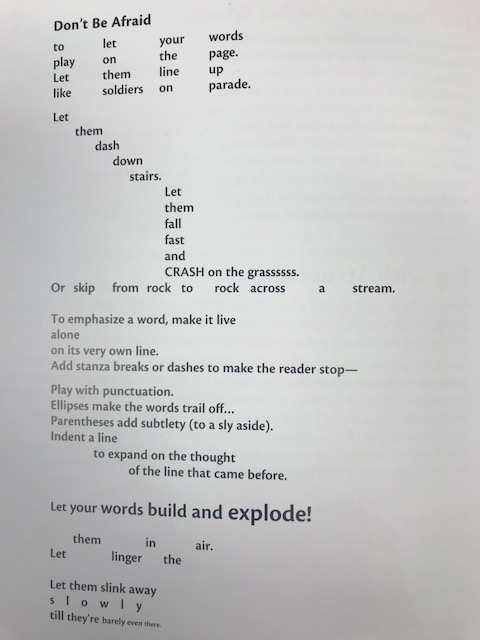
Afterward, I display "Don't Be Afraid" by Allan Wolf. It is a segment from Immersed in Verse, a beautiful book of lyricism that invites any writer into the world of writing poetry.

Image taken from Allan Wolf's website, linked above. 

For a few minutes, we discuss how Wolf modifies font size, style, and spacing to match topics and ideas within his poems. Students are always mesmerized by the variations in style and are eager to create their own.


So I let them. And they use the things they saw, heard, felt, smelled, and thought as the foundation for their poems.   


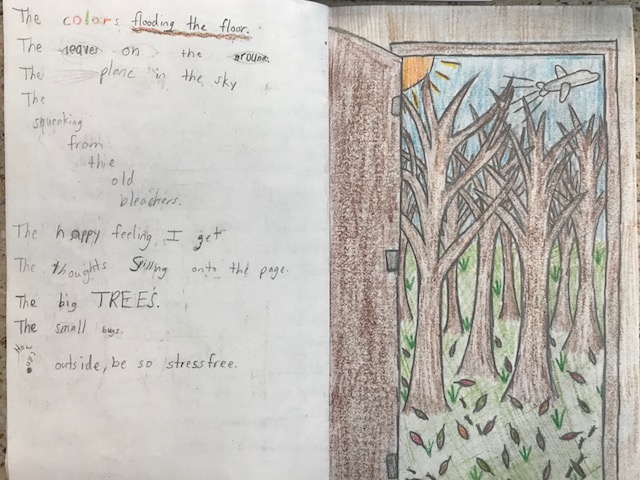
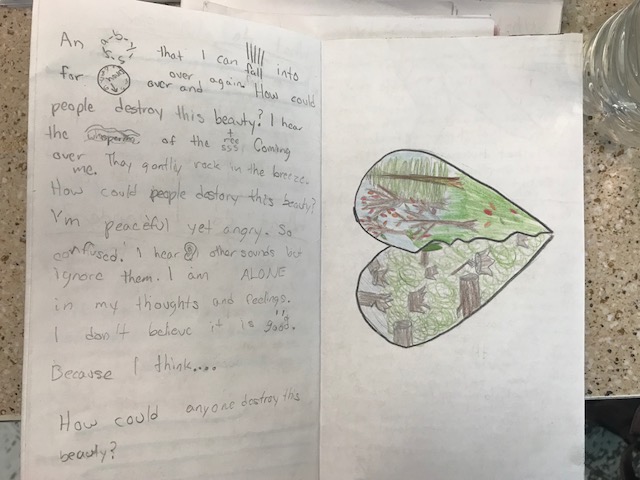
I give them time to play with language, with style, with spacing, and with imagery, much like the poem from Allan Wolf. It is here that students begin to understand purpose, tone, and how poetry can push us past the ostensible. Give them a chance to create. And be prepared to stand in awe of their creations, such as the examples below:


Further Reading:


Travis Crowder is a 7th grade ELA teacher in Hiddenite, NC, teaching ten years in both middle and high school settings. His main goal is to inspire a passion for reading and writing in students. You can follow his work on Twitter (@teachermantrav) and his blog: www.teachermantrav.com/blog.