Showing posts with label metaphor. Show all posts

Sunday, April 12, 2020

2020 Post #29 -- What Is Your House?

by Brett Vogelsinger

It is unprecedented to include two poems by the same poet in a single, annual series of Go Poems posts, but since "unprecedented" is the word of the day, it seems fitting.

Earlier this month, I shared how Idris Goodwin's poem "Say My Name" can inspire students to write about their own names.

Just days ago, Goodwin released a new poem, dedicated to all the children and parents trying to stay productive, creative, and sane while stuck at home.  It echoes the ideas about our human need to be creative that we read earlier this week in "Things to Do in the Belly of the Whale," but this time in practical, spot-on terms that children and adults need to hear in the spring of 2020.

Today's poem is called "Your House Is Not Just a House."


A challenge we might bring to students in a quickwrite during a live teaching session or via an online learning management system:  What is your house?  In what ways is it not "just a house" right now?

Share this poem and this prompt to see what your students create!

Further Reading:


Brett Vogelsinger is a ninth-grade English teacher at Holicong Middle School in Bucks County, PA.  He has been starting class with a poem each day for the past ten years. He is the creator of the Go Poems blog and the author of Poetry Pauses: Teaching With Poems to Elevate Writing in All Genres.   Find him on Twitter @theVogelman.


Thursday, April 2, 2020

2020 Post #19 -- Something You Should Know

by Rebekah O'Dell

If we English teachers could get together and dub a Reigning King of Poetry, I submit it would be Clint Smith. Smith, an English teacher himself, has been a favorite of many high school English teachers (especially those in the #TeachLivingPoets movement) in recent years due to both his incredible verse and his willingness to Skype with students and support teachers.

But let’s be honest: while Smith’s poetry is not difficult, it is heavy.

Teaching middle schoolers, my class needs scaffolding -- a strategy to help students make the figurative leaps of metaphor. And a scaffold to help students build confidence and write like Smith a little bit at a time. Naturally, the poem I chose to introduce Smith is his brilliant “Something You Should Know.”

Here’s how we did it in about 10 minutes of class time:

  • Read the poem aloud (project it or give a copy to students so they can see the words on the page, too. They’ll love seeing the trick at the beginning with the title flowing into the first line!)
  • Turn and Talk: The title of the poem is “Something You Should Know”. So, for the speaker of this poem, what is the thing that you, the reader, should know about him or her? What story does the speaker connect with this secret?
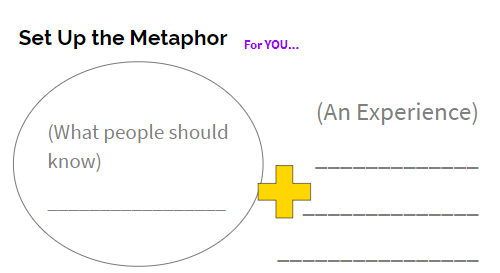
  • Share Out: This is a great time to talk about the idea of metaphor -- the speaker reveals his fear (being exposed and vulnerable) by telling us a story about something different (hermit crabs). Smith builds the metaphor by combining his secret with an experience. 
  • Grab Your Notebooks: Invite students to begin by building a metaphor in the same way that Clint Smith did. Give them a few minutes to try in their own notebooks.
I promise students they won’t have to share this, but they do have to try it. If a student or two finishes quickly, you can invite them to build additional metaphors!


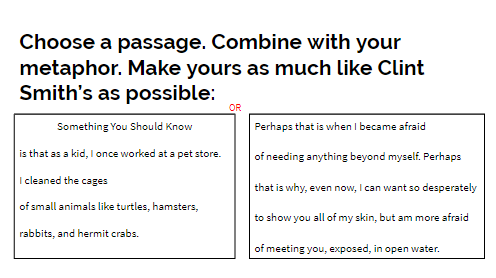
Once everyone has built a metaphor, they are ready to try a bit of Smith-inspired writing. Most of my students are not ready to launch into a full poem at this point, so we build confidence by approaching it in a smaller chunk:


Students choose to either write the first four lines (which focus on the experience/story part of the metaphor) OR the last four lines (which focus on the secret or the “something you should know”). Trying four lines is usually relatively undaunting. For students who are ready for more, they can choose to try BOTH the beginning and the end of the poem, or they can just keep writing -- fleshing out their poem as a whole.


Here are a few samples of students in my 7th grade trying their hand at this activity.


Something that you should know

is that when I was younger,

I remember watching a movie about birds.

My favorite part was the scene about the owls.

The silent but powerful creatures that only come out for a short amount of time.


Mathias


Something you should know

is that when I was a kid, I would help my mom prune flowers

I snipped the dead ones

but observed the buds that were shut up tight


June


Perhaps that is why I'm afraid of forgetting.

Perhaps that is why, even now, when I so desperately want to share how I feel,

I don't, I lock it away.

Because the outcome can be even more upsetting than forgetting.

Magovern


You’ll notice that some mimic Smith and others riff off of his lead. Either way, this activity leads students to a greater awareness of how to create powerful metaphors themselves and gives them a bit of poetry they can build on later!

Further Reading:


Rebekah O’Dell teaches middle school English in Richmond, Virginia. She is the co-founder of MovingWriters.org and the author of a number of professional books. You can find her on Twitter @RebekahODell1 and at movingwriters.org.

Friday, March 20, 2020

2020 Post #6 -- Scientific Facts and Philosophical Ponderings

by Cayne Letizia

Clint Smith is a writer, teacher, and doctoral candidate in Education at Harvard University. Besides the fact that Clint was a high school English teacher (which is awesome in its own right!), and he was also the 2014 National Poetry Slam champion for the poem American Dreams! 


Clint Smith has many poems that I love sharing with my middle school students. The poem Meteor Shower is a favorite of mine for how it weaves a simple science fact with philosophical ponderings. When sharing this poem, make sure to put on Space Odyssey music and project a NASA image on the board! The poem moves from the narrator sharing a science fact that they read when they were younger to a reflection on how that science fact is a message from the universe. The poem then continues exploring how that fun fact applies to life. 


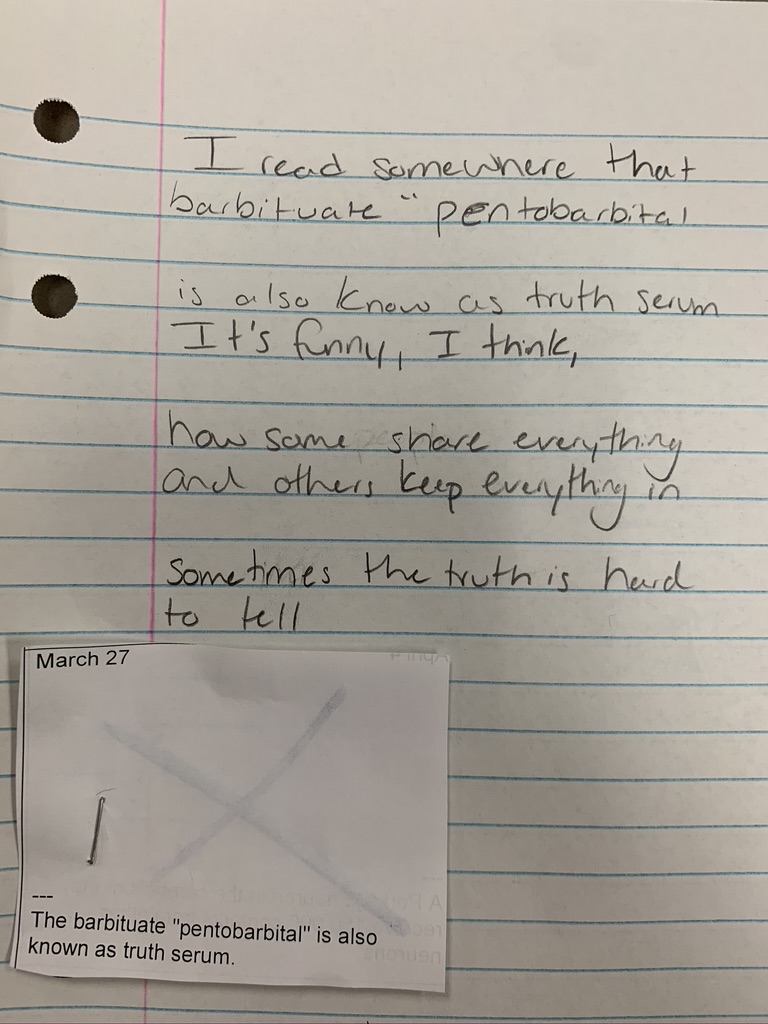
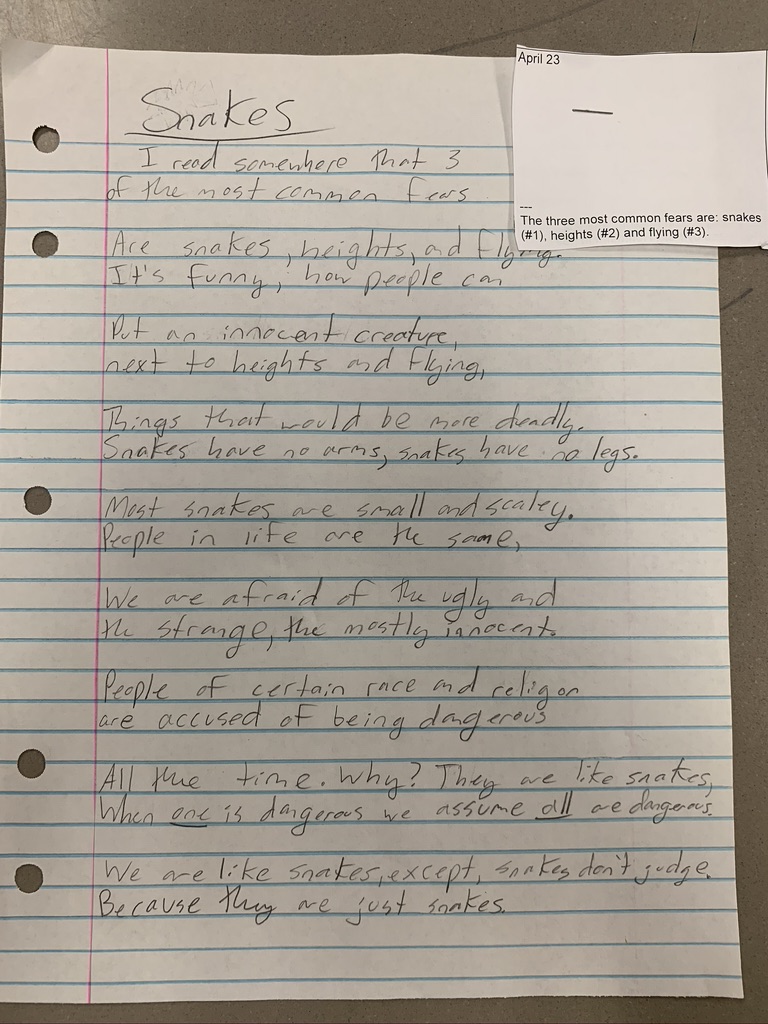
I distribute one of these cards or fun science facts to each student. But make sure to review them. Some are way better than the others. Some facts include ‘The barbituate "pentobarbital" is also known as truth serum.’ & ‘The term "homo sapiens" comes from the Latin words meaning "wise man."’ 


After reading the poem aloud and discussing it the students then use their science fact to create their own poem on how the fact relates to life. Check out some of these facts below with the accompanying student-generated poems. The one entitled Snakes was incredibly powerful!


Further Reading:


Cayne Letizia teaches 7th and 8th Grade English in a town just outside of NYC. This is his 20th year as an educator. He is passionate about literacy and social justice. You can follow him on Twitter here: @cayneletizia

Tuesday, April 9, 2019

2019 Post #26 -- Reading a Poem on Multiple Levels


by John Waite

I enjoy sharing the poem "white dove—found outside Don Teriyaki’s" by Juan Felipe Herrara with my students. It is the fifth of five of Herrera's poems published here by The Boston Review.

While this poem is very readable in terms of language and the basic story line, it offers several challenges for readers that make it an ideal text for students. It can be taken literally, about a man keeping a bird in a cage, or it could be read as symbolic of a parent-child relationship, which could be of interest to students. The form is also interesting. With its lack of punctuation and irregular line breaks it offers a chance to talk about the specific poetic techniques of form.

As a class, we look at this poem with an eye on analysis, theme, and writing craft.


Analytical Questions

1. How does the lack of punctuation affect the way you read the poem? Why might the author choose to do this?

2. Why do you think the author chooses to specify the gender of the birds?

3. Why do you think the author chooses such irregular line breaks? Is there any sort of pattern to them that you can detect?


Thematic Questions

1. How would you characterize the author’s relationship with the white dove?

2. Is the white dove better off with the speaker or in the wild?

3. How might this relationship mirror that of a parent and child?


Writing Prompts

1. Is it better to be safe or free? Why?

2. Pretend you are the white dove. What would you say to the speaker of the poem?

Further Reading:


John Waite is a teacher at Downers Grove North High School in Downers Grove, Il. He is a licensed Reading Specialist and National Board Certified Teacher. He also creates Trojan Poetry, a web series in which he and a colleague (Mike Melie) attempt to discuss poems on a weekly basis. Find it on YouTube and Twitter. Reach John at jwaite@csd99.org.

Monday, April 1, 2019

2019 Post #18 -- Where Are You From?

by Chris Kehan 

Where are you from? What makes you who you are? George Ella Lyon’s poem "Where I’m From" helps us get to the heart of that question. You can pose these questions to your students prior to reading the poem or after. Model on chart paper your list. Have them jot in their Writer’s Notebooks the answers. For students who may need more support have them split the page into 4 quadrants and label each one: family, friends, hobbies/interests, childhood experiences.

Have your students listen to George Ella read the poem aloud herself from her website. It gives authenticity and voice to the poem for your students to hear. Talk about how she "shows" rather than "tells" about where she’s from. Have a discussion with your students about what they think about where she’s from based off the stanzas. Point out the use of repetition (I’m from) at the start of various lines. 
 
Model writing a stanza from your list. Then allow your students time to write their own Where I’m From poems using her framework. Have them partner up to see if they showed where they’re from rather than telling. (Example: Not, I’m from basketball - Rather, I’m from sneakers screeching on the shiny court.) 

Point out the metaphor ending she uses. Brainstorm other metaphors to which life can be compared (i.e. book, ocean, flower, etc.). Model writing one. Have students try writing different metaphorical endings in their Writer’s Notebooks.

This poem is great to use at any point in the school year as it gives you and your students an opportunity to get to know one another and work on the craft of showing and not telling to describe where they’re from.

Further Reading:


Chris Kehan is a Library Media Specialist in the Central Bucks School District and a proud fellow of PAWLP (PA Writing & Literature Project) whose passion is teaching reading and writing to all grade levels and ages. Follow her on Twitter @CBckehan