
If we English teachers could get together and dub a Reigning King of Poetry, I submit it would be Clint Smith. Smith, an English teacher himself, has been a favorite of many high school English teachers (especially those in the #TeachLivingPoets movement) in recent years due to both his incredible verse and his willingness to Skype with students and support teachers.
But let’s be honest: while Smith’s poetry is not difficult, it is heavy.
Teaching middle schoolers, my class needs scaffolding -- a strategy to help students make the figurative leaps of metaphor. And a scaffold to help students build confidence and write like Smith a little bit at a time. Naturally, the poem I chose to introduce Smith is his brilliant “Something You Should Know.”
Here’s how we did it in about 10 minutes of class time:
- Read the poem aloud (project it or give a copy to students so they can see the words on the page, too. They’ll love seeing the trick at the beginning with the title flowing into the first line!)
- Turn and Talk: The title of the poem is “Something You Should Know”. So, for the speaker of this poem, what is the thing that you, the reader, should know about him or her? What story does the speaker connect with this secret?
- Share Out: This is a great time to talk about the idea of metaphor -- the speaker reveals his fear (being exposed and vulnerable) by telling us a story about something different (hermit crabs). Smith builds the metaphor by combining his secret with an experience.
- Grab Your Notebooks: Invite students to begin by building a metaphor in the same way that Clint Smith did. Give them a few minutes to try in their own notebooks.
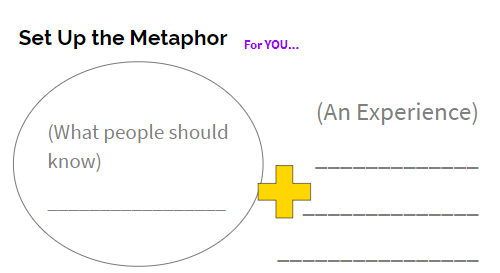
Once everyone has built a metaphor, they are ready to try a bit of Smith-inspired writing. Most of my students are not ready to launch into a full poem at this point, so we build confidence by approaching it in a smaller chunk:
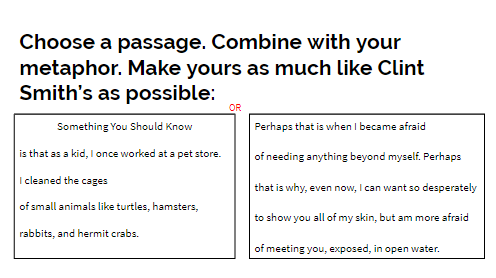
Students choose to either write the first four lines (which focus on the experience/story part of the metaphor) OR the last four lines (which focus on the secret or the “something you should know”). Trying four lines is usually relatively undaunting. For students who are ready for more, they can choose to try BOTH the beginning and the end of the poem, or they can just keep writing -- fleshing out their poem as a whole.
Here are a few samples of students in my 7th grade trying their hand at this activity.
Something that you should know
is that when I was younger,
I remember watching a movie about birds.
My favorite part was the scene about the owls.
The silent but powerful creatures that only come out for a short amount of time.
Mathias
Something you should know
is that when I was a kid, I would help my mom prune flowers
I snipped the dead ones
but observed the buds that were shut up tight
June
Perhaps that is why I'm afraid of forgetting.
Perhaps that is why, even now, when I so desperately want to share how I feel,
I don't, I lock it away.
Because the outcome can be even more upsetting than forgetting.
Magovern
You’ll notice that some mimic Smith and others riff off of his lead. Either way, this activity leads students to a greater awareness of how to create powerful metaphors themselves and gives them a bit of poetry they can build on later!
Further Reading:


Rebekah O’Dell teaches middle school English in Richmond, Virginia. She is the co-founder of MovingWriters.org and the author of a number of professional books. You can find her on Twitter @RebekahODell1 and at movingwriters.org.


