Thursday, March 26, 2020

2020 Post #12 -- In This Together

by Sylvia Vardell and Janet Wong

Teachers and administrators are doing heroic things on a daily basis to help families in their learning communities. Families are stepping up to comfort and educate children. But kids are still feeling a jumbled mix of emotions—joy over being able to sleep late, boredom due to social distancing, and anxiety over the uncertainties of the COVID-19 situation.

How can poetry provide relief?


By filling us with empathy.

By reminding us that there are helpers everywhere, people who can offer support.

By pointing to the good things, no matter how small.

By making us laugh.

And by doing all of the above, in most cases, in just a minute.

This is a perfect time to catch up on reading. But reading, in the traditional sense of placing eyes on words, can be very difficult right now. It’s just so hard to focus. Listening is slightly easier; this is one reason that many authors are offering read-alouds via social media. Author Kate Messner has gathered many author, illustrator, and poet read-alouds here. Also check out the resources of #OperationReadAloud on Facebook. And Audible is offering access to free audiobooks while schools are closed.


But fifteen minutes of quiet concentration, even if it’s passive listening, can still be hard. So here are some poems that take only 30 seconds each (on average), offered both as written text and also in video format. Some of the video offerings are “poem movies” featuring a montage of images; others are simply video readings. 

Step 1: listen to a few poems.
Step 2: if you like what you hear, read the text.
Step 3: if you really like the poem, use it as a writing prompt; put your own ideas down on paper.

Give it a try. If one of these poems brings you some hope, please spread the word. We are #inthistogether.

“Blue Bucket” by Naomi Shihab Nye (from HERE WE GO: A Poetry Friday Power Book by Sylvia Vardell and Janet Wong)

Poem Movie

Poem Text


“Look for the Helpers” by Michelle Heidenrich Barnes

Poem Movie


Video Reading (along with two other poems: “Bear” by Janet Wong and “Look for Birds” by Janet Wong)

Poem Text


Further Reading:


Sylvia Vardell is Professor in the School of Library and Information Studies at Texas Woman’s University; her current work focuses on poetry for children, including the nationally recognized blog, PoetryforChildren http://poetryforchildren.blogspot.com. Janet Wong janetwong.com is the author of more than thirty books for children and teens on a wide variety of subjects, including identity (A Suitcase of Seaweed & MORE). Together, Vardell and Wong are the forces behind the Poetry Friday books published by Pomelo Books. PomeloBooks.com

Wednesday, March 25, 2020

2020 Post #11 -- Poems Found in Feedback

by Sarah Gross

When I talk about poetry with my students it often elicits a groan.  We can usually get past the horror when we start reading contemporary poetry together and they realize, “Hey!  I can make sense of this!” because most of their experience with poems in the past is “old and boring” (in their words).  


But writing poetry?  That’s pretty terrifying for many of my students.  They either tell me outright that they can’t write poems or they sit in front of a blank document paralyzed by perfectionism.  How can they write a poem like the ones we’ve been reading?  Who will want to read their words?  It’s just too hard to write poems!


For that reason, I like to start with found poems.  Found poetry takes existing lines and reworks them for a new poem.  Students can make found poems from newspaper articles, other poems, novels, and any other text.  


My favorite found poem to share with students right now is “Dear Amy Nehzooukammyatootill” by Aimee Nezhukumatathil.  The poem takes lines from individual emails Nezhukumatathil received from high school students about her work and combines them into a new piece.  In an interview with superstition (review), a literary magazine, she says, 


“After receiving dozens of these emails, I noticed some repeated sentiments, almost chant-like, so to me, when reading all of these student emails together, I was very much drawn to the sounds first, content later. Of course I found the humor of dozens of high school students telling me quite openly and honestly what they thought of my first book and I was truly charmed and amazed at the lack of filter in their responses. The poem itself is just a tiny fragment of various responses that I received in a 24 hr period, but I think Annie Dillard talked about found poems best when she said, “…Turning a text into a poem doubles that poem’s context. The original meaning remains intact, but now it swings between two poles.”


Reading the poem and the interview immediately made me think of the feedback students receive all day long in school.  What would it look like if students followed Nezhukumatathil’s example and created a found poem from the feedback they receive?


For this activity, I ask students to read “Dear Amy Nehzooukammyatootill” as we listen to the recording on the Poetry Foundation website.  After we read it together we talk about what a found poem is. Students pull out their favorite lines from Nezhukumatathil’s poem and we discuss what the students might have meant when they included a particular line in the email versus what Nezhukumatathil means when she includes it in her poem.


Finally, I challenge students to create a quick found poem from the written feedback they have received from teachers.  We use Google Classroom for grading, so students can go back through their last few pieces and copy individual lines of feedback in different classes.  If they have hard copies of recent tests/assignments they can also pull lines from those.  


As a closing activity, ask students to share their poem with a neighbor (if they are comfortable).  

Further Reading:


Sarah Gross is one of the co-organizers of NerdCampNJ. She teaches in central New Jersey and loves spending time outdoors. Follow her on Twitter @thereadingzone

Tuesday, March 24, 2020

2020 Post #10 -- Trapped

by Nate Harris

During my first week teaching 9th grade English Language Arts, I gave my students what I thought was a simple writing diagnostic to complete, which asked them to do the following: Write about a time in your life when you felt trapped. You may write about being trapped physically or being trapped in some other sense, perhaps socially or emotionally.

After a few minutes of silent writing, one of my two English Language Learners, a 13-year-old girl from Russia, raised her hand. She proceeded to shyly ask me what the word “trapped” meant, and I did my best to give her a personal definition, followed by several examples. Not two minutes later, the same scenario played out with my other ELL student, a girl from Spain.

It was this scenario that inspired me to use Paul Laurence Dunbar’s poem "Sympathy" to introduce the concept of feeling trapped and review the poetic elements of rhyme scheme, end rhyme, and imagery.

As the year progressed, I also connected the poem to the themes of oppression and the power of empathy and sympathy that appear throughout my curriculum in texts such as To Kill a Mockingbird and Night. In order to fully make these connections, it is important to note (while introducing the poem) that Dunbar’s parents were born slaves, and so his voice as an observer of the oppressed and formerly oppressed is authentic and credible.

Further Reading:


Nate Harris is in his sixth year of teaching English Language Arts, and is excited and humbled to be a part of a collection of inspirational ideas. He has not had any social media since his senior year of college, but he can be reached at nharris@cbsd.org.

Monday, March 23, 2020

2020 Post #9 -- Adjusting to a Quiet World


Brett Vogelsinger retweeted this tweet from Jose Olivarez, and I was struck dumb for a moment:


I had never read this lovely poem, but it so played the right cultural and thematic chord (a government restriction on words, apparent social isolation, simplicity in community and love and humanity) that I instantly knew I was  using Jeffrey McDaniel's “The Quiet World” as the first poem in my distance learning plan.

Taking a page from Carol Jago, I wanted my students to simply experience the poem, and I wanted to give them two very simple directions. First, I invited students to tell me the line that struck them the most, something we always do in class when we first read a poem. The poem’s power is in its emotional use of language, which plays on the fact that conversation is limited to one hundred and sixty-seven words a day, so students’ choice of lines would be a wonderful entry point into thinking about the poem’s large themes of connection, love, and humanity. Once they’d chosen their line, I simply wanted them to tell me how this poem and its themes felt resonant during this pandemic where we are social distancing and distance learning.

The trick of this lesson was in how they shared their responses. I posted my own response to our class Flipgrid (click here to see my video) so the students could see and hear my own words, which felt important for the poem’s themes and for our current social isolation. I then encouraged them to record their own videos based on my two directives.


Seeing students’ faces and hearing their voices while they talked about isolation, humanity, and community—this was a win. And having a virtual discussion about the power of words and the importance of making real connections especially in the face of crises like the COVID-19 pandemic was a terrific reminder of how powerful poetry can be in shaping how we see the world around us.

Here are some student Flipgrid response excerpts about the poem’s connection to the pandemic:

“I think this [personal connection] relates to what is going on right now because we’re all so lonely in our houses so if we call our friends on the phone and we’re not even talking—we’re just doing our homework or something—like you still feel someone is there with you and you’re less alone.”

“…making sure we say, ‘I love you’ and talking to people that we love is in important. And I think that goes along with what is happening now just because we can’t really see people that we want to see, so making sure we stay connected to them through things like [Flipgrid] and on our phone is how we can stay connected.”

“Because of the coronavirus, we’re all so distanced from each other and people are always saying on social media...that we need to stick together and that’s where I feel the connection [to this poem] is.”


Further Reading:


Will Melvin teaches tenth and eleventh-grade English at CB South High School in Warrington, PA.  Follow him on Twitter (@WillMelvinCBSD).

Sunday, March 22, 2020

2020 Post #8 -- If

by Amy Ludwig VanDerwater

Sometimes the most difficult part of writing is revising. Sometimes the most difficult part of writing is feeling brave enough to share one’s own words with another. And sometimes the most difficult part of writing is getting started.

Try beginning a poem draft with one word -- the word "if." For when these two letters combine in this order -- i and then f -- worlds shift and change. We can lead with an if tied to a wonder...or an if clinging to a hope. We can write about our lived lives or imagined worlds. We can write about history or about today or about a future near or far from now. We can write about serious subjects and about lighthearted subjects. An if poem can include one if or many.


If you and I had never met…

If my mother was a koala bear…

If he found a rock and if the rock could talk…

If forgiveness was easy...

If someday our grandchildren live on the moon…

If you helped build the pyramids…


Starting a draft with this wee word, we can then choose to write in the first person (I or we), the second person (you), or the third person (he/she/they). Each choice matters.

The first three stanzas of Truth - from my newest book, WRITE! WRITE! WRITE!, beautifully illustrated by Ryan O’Rourke - leads with "if."

From Write, Write, Write! by Amy Ludwig VanDerwater, 2020, linked below. 


In my poem Like Windowpanes, I use the word only once, to invite a reader in.


In his famous poem titled "If," Rudyard Kipling repeats this gem of a word again and again, each time layering its meaning with more love and possibility, as the kinetic typography video below demonstrates well:


Read the whole poem HERE

It can be lovely to be handed a beginning. “Start here,” a friend says. And somehow, with a trusted soul holding this literary door for us, we do.

Further Reading: 


Amy Ludwig VanDerwater is author of several books for children including FOREST HAS A SONG, EVERY DAY BIRDS, READ! READ! READ!, DREAMING OF YOU, WITH MY HANDS: POEMS ABOUT MAKING THINGS, and her most recent WRITE! WRITE! WRITE! She is also author of the professional book POEMS ARE TEACHERS: HOW STUDYING POETRY STRENGTHENS WRITING IN ALL GENRES. Amy lives in an old farmhouse in Western New York, and blogs poetry and lessons at www.poemfarm.amylv.com.


P. S.
A GIVEAWAY!
Boyds Mills & Kane will generously offer a copy of Write, Write, Write! to a commenter on this post. Be sure to include your Twitter handle or email address so that Brett can contact you. Winner announced 3/24/20 on Twitter. 

Saturday, March 21, 2020

Post #7 -- Falling In Love With Poetry

by Todd Nesloney

When I was growing up, I hated poetry. It didn’t interest me and it made zero sense. In reality, the only kind of poems that I was introduced to were poems written by people like William Shakespeare.

Now don’t get me wrong here, I believe there is a time and a place for poetry like that. But it never has been a place of inspiration for me.

When I read, I want to feel inspired. I want to feel like someone just took the words straight out of my heart and placed them down on paper far better than I ever could. That’s when I learned about poetry that could lure me in and hold me for hours.

When I work with students now, I try to find poets that write in a way that feels present, relevant, and honest but in a way that also provides a sense of hope.

Recently I came across the author Tanner Olson (who goes by @WrittenToSpeak on social media). I was so deeply moved by many of his graphics or blog posts he would share. Then I bought his book I’m All Over the Place, and immediately fell in love.

Tanner writes in a way that tugs at my heart, expresses my complicated thoughts, but also links in hope. "To" is one poem that demonstrates this well; it is worth sharing with students!


When working with students sometimes there is just immense power in showing a poem and asking how it makes our students feel. Allow them to express those feelings within their own writing, an artistic rendering, or even verbally expressing it. But most importantly? Making sure you, the teacher, share how it tugged at your own heartstrings. What memories or emotions did it bring up for you? Be vulnerable, be honest, be real.

Further Reading:


Todd Nesloney @techninjatodd is the Director of Culture and Strategic Leadership for the Texas Elementary Principals and Supervisors Association. He has been recognized by John C. Maxwell, the White House, and more for his work in education. He has also published several books including Kids Deserve It and his brand new children's book Spruce and Lucy.

Friday, March 20, 2020

2020 Post #6 -- Scientific Facts and Philosophical Ponderings

by Cayne Letizia

Clint Smith is a writer, teacher, and doctoral candidate in Education at Harvard University. Besides the fact that Clint was a high school English teacher (which is awesome in its own right!), and he was also the 2014 National Poetry Slam champion for the poem American Dreams! 


Clint Smith has many poems that I love sharing with my middle school students. The poem Meteor Shower is a favorite of mine for how it weaves a simple science fact with philosophical ponderings. When sharing this poem, make sure to put on Space Odyssey music and project a NASA image on the board! The poem moves from the narrator sharing a science fact that they read when they were younger to a reflection on how that science fact is a message from the universe. The poem then continues exploring how that fun fact applies to life. 


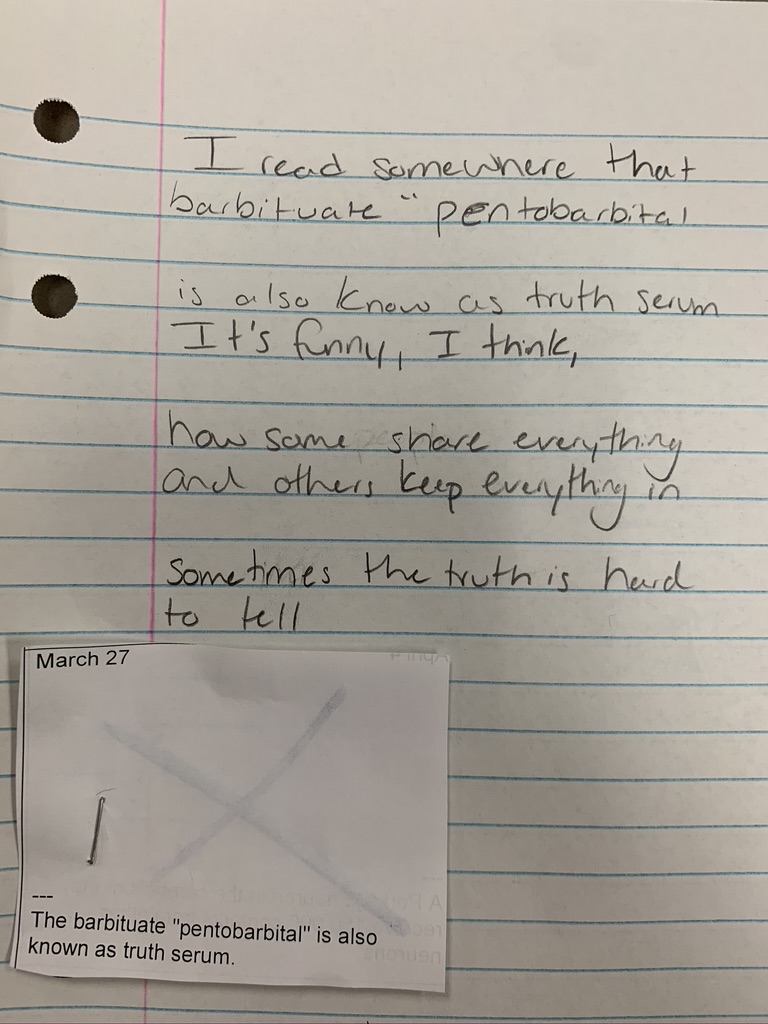
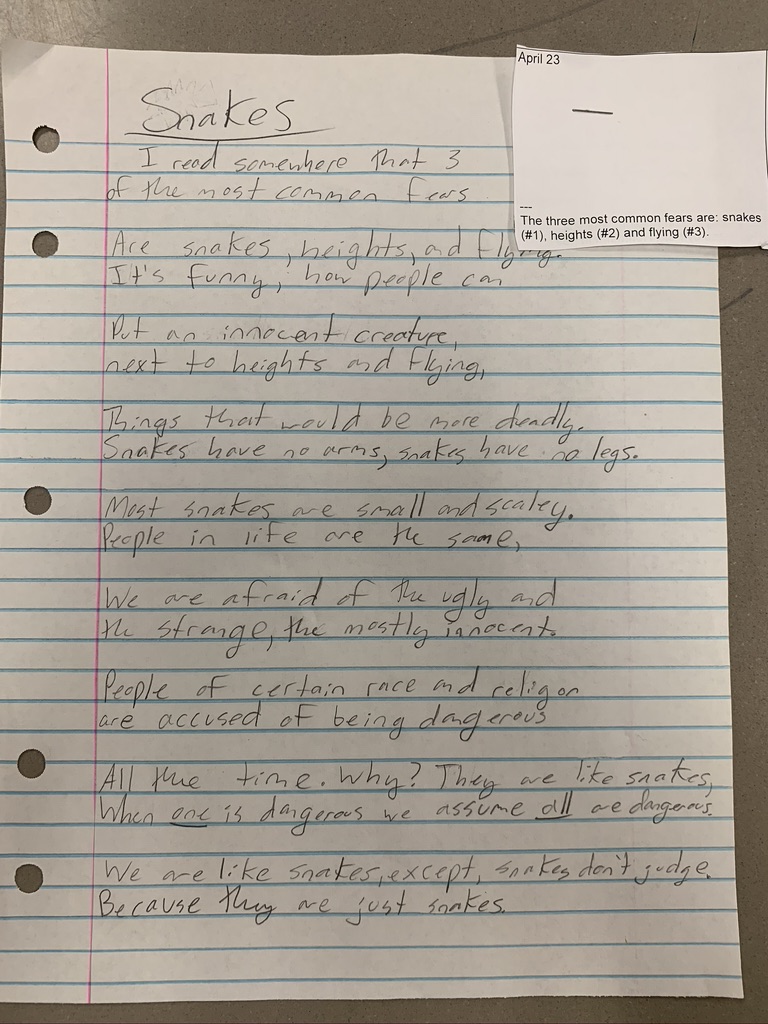
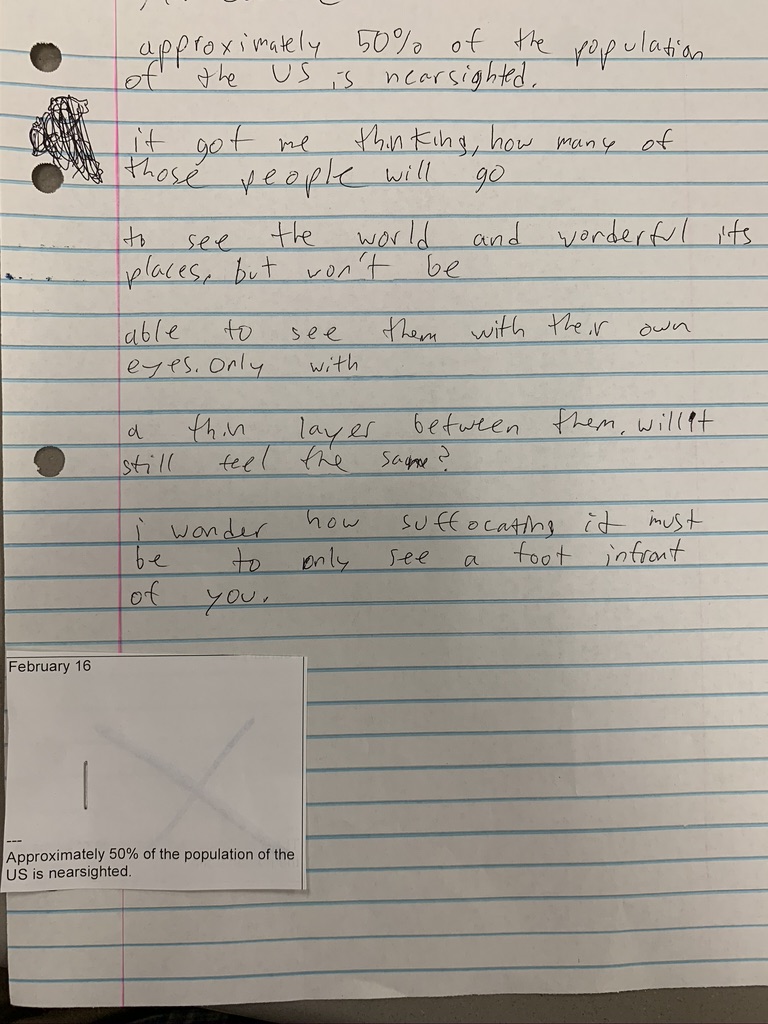
I distribute one of these cards or fun science facts to each student. But make sure to review them. Some are way better than the others. Some facts include ‘The barbituate "pentobarbital" is also known as truth serum.’ & ‘The term "homo sapiens" comes from the Latin words meaning "wise man."’ 


After reading the poem aloud and discussing it the students then use their science fact to create their own poem on how the fact relates to life. Check out some of these facts below with the accompanying student-generated poems. The one entitled Snakes was incredibly powerful!


Further Reading:


Cayne Letizia teaches 7th and 8th Grade English in a town just outside of NYC. This is his 20th year as an educator. He is passionate about literacy and social justice. You can follow him on Twitter here: @cayneletizia

Thursday, March 19, 2020

2020 Post #5 -- Say My Name

by Brett Vogelsinger

The poem "Say My Name" by Idris Goodwin requires no real introduction, as the poem is so engaging, students will jump right in.  It is a poem about the many stories behind a name,  stories of both how that comes to be ours and what others try to do with it. I was pleased to find this on the #teachlivingpoets Black History Month list alongside many other phenomenal spoken word poems to build into our routine.


After sharing the video, I share a series of questions as my students open their Writer's Notebooks:

How did you get your name? Is there a story behind it you could tell poetically?
Do you know your "almost" name . . . the name your parents were thinking about but did not choose?
Do people mispronounce your name?  If so, how?
Are there common mispronunciations that you hear people use in everyday speech that bug you?
Are there any words you intentionally mispronounce?  Why do you make this choice?

We freewrite for about three minutes to one of these questions, then share in small groups whatever writers are willing to share from their work.  Several of my students gave me permission to share their drafts with Idris Goodwin via Twitter, and were thrilled to see him respond.

This whole activity only takes about ten minutes at the beginning of class, but it plants seeds that we can return to later for personal narrative writing or a more polished poem.  Moreover, students opened up an shared bits of their personal history after hearing Goodwin's poem; this activity built community among my writers.

A Related Post on Go Poems

Further Reading:


Brett Vogelsinger is a ninth grade English teacher and NBCT at Holicong Middle School in Doylestown, PA. He is the founding editor of Go Poems, facilitates his school's literary magazine, Sevenatenine, and contributes monthly posts at Moving Writers. Follow him on Twitter @theVogelman.