Showing posts with label spoken word. Show all posts

Friday, April 8, 2022

2022 Post #25 -- Jimmy Fallon

by Jason Hepler

Admission: while I am a middle-aged married man and father of four, I have had a man crush on Jimmy Fallon ever since his time on Saturday Night Live. Consequently, I was ecstatic when he became host of and have since watched every episode of The Tonight Show starring Jimmy Fallon. All nine seasons, totaling 1627 episodes as of April 1, 2022 -though mostly after DVR’ing them.


As I write that, I am not sure if that is a badge of honor, find a hobby, or a need to seek counseling.

Regardless, I have seen and enjoyed them all. In addition to Jimmy’s charm and amicability, I love the witty writing, the childish sense of humor, and the creativity of skits such as “Tonight Show Superlatives,” “Freestyling with the Roots,” and Fallon and Kevin Bacon’s “First Drafts of Rock.”

Several of my favorite bits involve the use of random generator (as seen below).


While I know a random generator is not unique to Jimmy Fallon, it was while watching an episode, amidst my boyish giggling, where I thought, “This could work in English class!”

And thus, my Random Poetry Writing Assignment was born.

During National Poetry Month we read a poem a day, trying to explore and maybe even teach a little about a variety of genres. As the month nears its end, students take a turn with my randomizer. While I can’t afford fancy graphics or cool sound effects, the premise is simple: each student will draw a genre, a topic, and a silly word (though my generator has changed several times over the years by using a character from a novel, vocab words that we study, pop culture references, etc.).

They are then to compose a poem meeting the criteria of their randomizer. The combinations can provide a sense of -dare I say- fun: a limerick about pickles with the word whippersnapper, a narrative poem about slow Wifi that contains the word onomatopoeia, or a sonnet about hangnails including the word hullaballoo.

The assignment often forces them to explore definitions, revisit poetry/genre specifics, and tap into their creativity. Mostly, it allows them to interact with language -which is one goal of poetry. And the structure of it all usually turns out to be a winner in the kids’ eyes -which is the main goal of teaching anything really.

In addition to the randomizer idea that spawned from the show’s skits, I also show the spoken word performances that have appeared over the years. I always use the clips directly from The Tonight Show’s YouTube page to reinforce the notion of how mainstream poetry is.

Two of my favorites are Rudy Francisco’s performances from his collection Helium – “Complainers” and “Rifle II.” Both are very well received by students and have provided a myriad of discussion possibilities. And it almost always leads to requests for my copies of Helium.

His support for poetry and poets makes me only love him more. But I promise, it’s in a healthy, non-stalkerish kind of way.

Further Reading:


Jason Hepler is an eighth-grade English teacher and basketball coach in Bucks County, Pennsylvania. 

Saturday, April 3, 2021

Post #20 -- Learning Beside Oregon's Poet Laureate, Anis Mojgani

by Penny Kittle

I am from the green of Oregon in mid-June when the sun is up early and the trout are biting in every pond. I was born and raised in the beauty of my favorite state, and it still sings inside of me. So I was thrilled, as you can imagine, when I learned that a favorite poet of mine, Anis Mojgani, had been chosen as the 10th annual Oregon Poet Laureate. He follows the two-year-term of Kim Stafford, son of legendary William Stafford, who served in the role for 15 years. Oregonians know poetry: it is in the sky in September, at Cannon Beach just after a wild windstorm, and in the view from the summit of Mt. Tabor where I walk each morning on my annual trip home.

Mojgani is a two-time National Slam Poetry Champion, and you simply must watch his 2010 performance of “Shake the Dust” on YouTube. Click now and find it. I’ll wait. Anis brings such a gentle compassion to this poem. Students respond to his call for imagining the lives and struggles of others. They want to write next to this poem.


I have used Mojgani’s poem in middle and high school classrooms for the last 11 years. I give each student a copy of the words to the poem, and then I show Anis’s performance of it. I want students to have the words when they are ready to write. Following his performance, I open my notebook and tell students I’m going to imitate his poem with my own lines:


For the new student who doesn’t know where to sit at lunch, shake the dust.

For the grandmother lonely in her room in a nursing home, shake the dust.


With each line, I tell students, I imagine someone I know who is hurting and write for them.

We all write together. The room fills with words spinning from hearts to paper. We imagine, we write, we fiddle with language and lines, and we create something beautiful in our notebooks. There is no grade, no rubric, just an opportunity to write our thinking. This essential daily practice in first draft writing builds confidence. Imitation allows all students to feel successful as they begin to trust their words and ideas on the page.

After several minutes, I ask students to underline a few lines they feel capture something important. We end this practice with a whip share—where each student has the chance to read a line or two out to the class (or pass, of course.) I love to gather these notebooks and create a class poem from their lines, which I share the next day. Community poems bind us together.

You can learn more about Anis Mojgani and his poetic genius at thepianofarm.com. Or follow him on Twitter @mojgani, Instagram @thepianofarm, or Facebook Anis Mojgani.

Further Reading:


Penny Kittle teaches freshman composition at Plymouth State University in New Hampshire. She was a teacher and literacy coach in public schools for 34 years, 21 of those spent at Kennett High School in North Conway. She is the co-author of 180 Days with Kelly Gallagher, and is the author of Book Love, and Write Beside Them, which won the James Britton award.

Friday, April 2, 2021

2021 Post #19 Written to Inspire Your Younger Self

 by Brett Vogelsinger

How many times in life do adults wish to go back and ask for a redo in their younger years?  How often do we wish we could time-travel and offer that younger version of ourselves some sage advice?  

This poem, "Seventeen" by Rudy Francisco imagines this possibility.  While the poem is about building up the courage to talk to someone you like and maybe even love, it is also about so much more.  It is about the social hierarchy of high school, male body image, introversion, and confidence, and Francisco's acrobatic skill with simile.  


After listening to this poem, ask your students to write a note, a letter, a poem, a list that they would give to a younger self.  In my school, grades 7-9, it is creatively fruitful to ask my ninth-graders to write to their seventh-grade selves.  Can you use a simile or two like Rudy Francisco does to bring to life what you felt back then or to add dimension to the wisdom you are able to pass on now as an older-but-wiser version of yourself?

I find that sometimes in workshops like this it is better to ask (or cajole) a few volunteers to share their work in class rather than insist everyone turn to a partner and read their writing out loud.  I let my students know this before they write so that they can feel comfortable expressing even thoughts and ideas they feel are deeply private.  The writer's notebook can be a space to write with such candor, but only if our students know how, when, and why they are expected to share, and what to do when they feel they cannot share. 

Depending on the number of volunteers to share with an audience, I might have a little time left for a deeper question raised by this poem:  How does our life experience shape our identity?  

Further Reading:

If you like this poem, check out another post featuring Francisco's "My Honest Poem" from earlier this year on Go Poems.  


Brett Vogelsinger is a ninth-grade English teacher at Holicong Middle School in Bucks County, PA.  He has been starting class with a poem each day for the past ten years. He is the creator of the Go Poems blog and the author of Poetry Pauses: Teaching With Poems to Elevate Writing in All Genres.   Find him on Twitter @theVogelman.


Saturday, March 20, 2021

2021 Post #6 --An Honest Poem

by Angela Stockman

Too often in my work with young writers, I’m reminded of how daunted many are by the prospect of creating a poem. This is what happens when we diminish what writing truly is. It’s not the use of written words alone, and it never has been. Writing--and especially poetry--is multimodal expression.

Rudy Francisco reminds us of this in My Honest Poem. Watch and listen, and as you do, document what you notice about the expressive modes that shape his composition. Pay attention to the way he uses his voice. Study his gestures. Notice how he moves his eyes and when. It isn’t a keyboard, pencil, or paper that makes his hands power tools. He’s still using them to craft poetry, though. Watch.


Here’s what’s exciting: When we invite writers to craft poems using more than written words, we ignite hope in the hearts of many who refuse to define themselves as writers, let alone poets.

Francisco’s performance is a perfect mentor text for those eager to compose honest poems of their own.

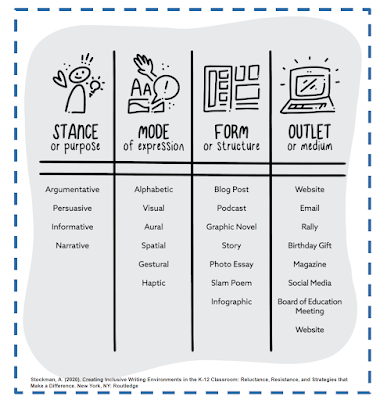
Begin by defining the six different modes of expression (see below) and inviting writers to analyze them inside of different multimodal compositions. Consider the choices each poet made regarding message, mode, form, and outlet. Notice how some poets need to speak their words while others use illustrations. Some prefer to situate photographs within a page, wrapping written words around them. Others may do all of these things and more.

Consider sharing Francisco’s poem with your students. Use it to challenge common assumptions about what poetry is and how we compose it. Then, invite them to get beyond the use of written words themselves. The chart below might help all of you imagine the possibilities.


Further Reading:


Angela Stockman is an instructional designer, writer, and professional learning facilitator who serves teachers of writing. She is the author of three books on this topic, the most recent being Creating Inclusive Writing Environments in the K-12 Classroom: Reluctance, Resistance, and Strategies that Make a Difference (Routledge, 2020). You may find her on Twitter @AngelaStockman.

Saturday, March 21, 2020

Post #7 -- Falling In Love With Poetry

by Todd Nesloney

When I was growing up, I hated poetry. It didn’t interest me and it made zero sense. In reality, the only kind of poems that I was introduced to were poems written by people like William Shakespeare.

Now don’t get me wrong here, I believe there is a time and a place for poetry like that. But it never has been a place of inspiration for me.

When I read, I want to feel inspired. I want to feel like someone just took the words straight out of my heart and placed them down on paper far better than I ever could. That’s when I learned about poetry that could lure me in and hold me for hours.

When I work with students now, I try to find poets that write in a way that feels present, relevant, and honest but in a way that also provides a sense of hope.

Recently I came across the author Tanner Olson (who goes by @WrittenToSpeak on social media). I was so deeply moved by many of his graphics or blog posts he would share. Then I bought his book I’m All Over the Place, and immediately fell in love.

Tanner writes in a way that tugs at my heart, expresses my complicated thoughts, but also links in hope. "To" is one poem that demonstrates this well; it is worth sharing with students!


When working with students sometimes there is just immense power in showing a poem and asking how it makes our students feel. Allow them to express those feelings within their own writing, an artistic rendering, or even verbally expressing it. But most importantly? Making sure you, the teacher, share how it tugged at your own heartstrings. What memories or emotions did it bring up for you? Be vulnerable, be honest, be real.

Further Reading:


Todd Nesloney @techninjatodd is the Director of Culture and Strategic Leadership for the Texas Elementary Principals and Supervisors Association. He has been recognized by John C. Maxwell, the White House, and more for his work in education. He has also published several books including Kids Deserve It and his brand new children's book Spruce and Lucy.

Thursday, March 19, 2020

2020 Post #5 -- Say My Name

by Brett Vogelsinger

The poem "Say My Name" by Idris Goodwin requires no real introduction, as the poem is so engaging, students will jump right in.  It is a poem about the many stories behind a name,  stories of both how that comes to be ours and what others try to do with it. I was pleased to find this on the #teachlivingpoets Black History Month list alongside many other phenomenal spoken word poems to build into our routine.


After sharing the video, I share a series of questions as my students open their Writer's Notebooks:

How did you get your name? Is there a story behind it you could tell poetically?
Do you know your "almost" name . . . the name your parents were thinking about but did not choose?
Do people mispronounce your name?  If so, how?
Are there common mispronunciations that you hear people use in everyday speech that bug you?
Are there any words you intentionally mispronounce?  Why do you make this choice?

We freewrite for about three minutes to one of these questions, then share in small groups whatever writers are willing to share from their work.  Several of my students gave me permission to share their drafts with Idris Goodwin via Twitter, and were thrilled to see him respond.

This whole activity only takes about ten minutes at the beginning of class, but it plants seeds that we can return to later for personal narrative writing or a more polished poem.  Moreover, students opened up an shared bits of their personal history after hearing Goodwin's poem; this activity built community among my writers.

A Related Post on Go Poems

Further Reading:


Brett Vogelsinger is a ninth grade English teacher and NBCT at Holicong Middle School in Doylestown, PA. He is the founding editor of Go Poems, facilitates his school's literary magazine, Sevenatenine, and contributes monthly posts at Moving Writers. Follow him on Twitter @theVogelman.

Tuesday, March 17, 2020

2020 Post #3 -- Sarah Kay and the Power of Lists

by Candace Brobst

Sarah Kay has the power to convince even the most jaded students among us that poetry isn’t so bad. She is both poet and hypnotist, and April is a time when teachers are perhaps more in need of the latter. To be honest, there are days in April where T.S. Eliot’s “The Waste Land” doesn’t seem so bad.


I teach Seniors, by choice I might add, not because my school’s administration is trying to punish me. And by April, student engagement is waning. Seniors have grabbed the nearest scissors, and they are cutting their own umbilical cords to anything school related. Younger students are no doubt also feeling the restlessness of spring, the home stretch, whatever. I like to capture that I-have-something-to-say-before-I-go energy with Sarah Kay’s “If I Should Have a Daughter…” TED Talk.


The entire TED Talk (18 minutes) is a you-can-do-this tutorial and inspiration for writing performance poetry so if you have a whole period, keep going. Have students become the virtual participants in Kay’s master class. There’s even another great poem at the end.


But if time is short, and you are trying to follow Brett’s lead with this poem-a-day challenge, just play the poem (the first three and a half minutes of the TED Talk). Kay assumes the role of an imaginary mother giving advice to her imaginary daughter. In the spirit of the poem, direct students to become the sages (a.k.a. mothers 😉). Have them create a quick list, as in: “Things I Know to be True” or “I Wish I had Known…” From there, Pair-Share, throw ideas on the whiteboard, or make a Nearpod Collaborate! Board.


Seniors in particular can do this as a culminating reflection on high school. Start with a list they can ultimately use to write letters to younger versions of themselves, armed with what they now know… things like: “Don’t wait until Senior year to take that first art elective” or “Audition for the musical; you are going to meet your best friends.” One year, my school (graduating class around 1000 students) had Seniors write letters of advice to incoming Freshmen. Distributing them was a logistical nightmare (one we never repeated), but it may work better in smaller districts.  

Further Reading:


Candace Brobst (brobstc@parklandsd.org) teaches English and Creative Writing at Parkland High School in Allentown, PA. She very much enjoys receiving assignments from former students.


Postscript: OK, OK, this is Brett writing now and I need to explain the last line of that bio . . . Candace Brobst is my high school creative writing teacher and one of the MAJOR early influences. My love of reading and writing poetry owes so much to this wonderful teacher, and I feel so honored that she agreed to write a post to my blog project.

Friday, April 6, 2018

2018 Poem #23 -- All Things Big and Small

by Zachary Sibel

In the world of spoken word poetry, it is hard to beat the work of Rudy Fancisco. His work is powerful, brilliant, and highly entertaining. While his videos are incredible -- and I suggest you use as many as you can -- his recently published anthology, Helium, presents a number of written texts that fit well as a warm-up in any class.

One text that I have used recently is a poem he first published via social media and later used in his book.


Find this poem in Rudy Fransisco's book, Helium, or in the original tweet.  

This poem is simple and presents an abundance of opportunities to talk about language and narrative.

Before introducing this poem, I talk to students about some fears that I have, things like flying and heights. I ask students if they have any fears and discuss whether they are rational or not. I end the brief discussion with what seems to be a surprising statement for some students: that I am terrified of spiders. I then show them this poem on my screen. I read the poem aloud and ask for a student reading.

The discussion can go a number of ways. Focus on the first half: "How does the poet react when asked to kill a spider, a task we all have probably done without giving it much thought?” Or focus on the second half of the poem: “What profound statement is made about the refusal of a simple task, killing a spider”.

I start with these questions but also allow student to just talk about the poem and what they got out of it. I close the discussion with the fact that since reading this poem a year ago, I haven’t killed a spider. Because of the way Fancisco addresses the idea of being “caught in the wrong place/at the wrong time, just being alive” I have tried to treat all things with a greater sense of kindness and mercy. Poetry can change us.

A suggested pairing: Read this text alongside William Blake's "The Fly"  and allow students to analyze “How does poetry allow us to see large concepts in the smallest of creatures?”

Further Reading:


Zachary Sibel is a hip-hop fan and an eighth-grade English teacher at Tohickon Middle School in Bucks County, PA. 

Sunday, April 9, 2017

Go Poem #26-- Paraphrasing A Rebuttal

by Brett Vogelsinger

Any strong argument can be countered in a rebuttal, and Taylor Mali's "Like totally whatever, you know?" from yesterday's post is no exception.  Melissa Lozada-Olivia answers Mali's attack on our lackadaisical use of language not with excuses but with powerful commentary on what voices with a lack of conviction might say about society at large.

I explain to my students that today's poem will be a poetic rebuttal to yesterday's poem.  No further introduction is required. 


It's fascinating to see that in my classes, the students invariably become defensive of Mali's argument. "He didn't mean it that way!" they cry, "She sounds too angry!" they judge.  To be honest, as a Taylor Mali fan (after all, what teacher doesn't love Taylor after hearing "What Teachers Make") I kind of relate.  But I invite my students to step back from their initial emotional reaction and consider the same question as yesterday: What is her central claim?  What is she arguing in this poetic response? 

This argument is somewhat trickier, but we eventually whittle it down to something like "People speak without conviction because they are used to being overlooked an unheard" or "Judging people based on how they speak will not help them speak with greater conviction."  We discuss whether this is in polar opposition to Mali's argument or just a different perspective on the same issue.  Do both poets believe people have the capacity to speak with greater conviction?  Is there any common ground here? 

The clever repurposing of Mali's own wording here is also worth noting.  Imitation, after all, is not always the sincerest form of flattery.  

When I shared this pair of poems with a colleague in my school district, she pointed out that the rap battle pieces between Thomas Jefferson and Alexander Hamilton from Hamilton (Original Broadway Cast Recording) would make excellent argument/rebuttal poems for discussion as well. 

Brett Vogelsinger teaches freshman English students at Holicong Middle School in Doylestown, PA where he starts class with a poem each day. Follow his work on Twitter @theVogelman.

Saturday, April 8, 2017

Go Poem #25 -- Paraphrasing An Argument

by Brett Vogelsinger

Taylor Mali's  poem "Totally like whatever, you know?" is so much fun partially because it pokes fun at something that is so incredibly true, you know, the way we, like, clutter our speech with totally needless words.  Kids identify with this because they are accustomed to teachers and parents pointing out their superfluous interjections and asking them to work on it.


After watching this poem in the kinetic typography rendition, I ask kids to look at the complete text of the poem on the screen and ask them to consider the piece again less as a poem and more as a piece of argument writing.  If this whole poem is an argument, what is Mali's central claim?  How can you tell?

Many students come up with something like "People need to speak with more conviction."

Then we can consider in a whole-class discussion how he uses details in other lines of the poem as evidence to support this claim and build a strong argument.

Tune in tomorrow to see another poet's rebuttal to this argument which is sure to provoke a response from your students.

Brett Vogelsinger teaches freshman English students at Holicong Middle School in Doylestown, PA where he starts class with a poem each day. Follow his work on Twitter @theVogelman.


Further Reading:


Wednesday, April 5, 2017

Go Poem #22 -- Mood Music

by Lisa Levin

Musician Jeff Tweedy recently turned Carl Sandburg’s poem “Theme In Yellow” into “an airy, idyllic folk song” that appears on Brooklyn musician David Nagler's tribute album, Carl Sandburg's Chicago Poems.


The poem describes a midwestern October and is filled with images of "prairie cornfields / Orange and tawny gold clusters" and children "singing ghost songs / And love to the harvest moon" while gathered around a pumpkin (or someone pretending to be a pumpkin), who serves as the poem's speaker.


I project the text of this poem on the screen while my students listen to the song. I tell the students very little beforehand, except that they should try and ascertain whether the poem develops a story from the images the poet creates. After the song, I ask a student to volunteer to read the poem to the class. Next we discuss the literary element of mood. Students define the mood of the poem and then provide lines from the poem as supporting evidence. It was interesting that half of the students found the mood to be peaceful and half found the mood to be sinister!

Lisa Levin teaches ninth-grade English at Holicong Middle School in Doylestown, PA.


Further Reading:


Wednesday, March 22, 2017

Go Poem #8 -- A Poem in Two Languages

by Brett Vogelsinger

I must confess, I am a little partial to the poem "Revenge" by Taha Muhammad Ali because I was present for its English-language debut at the Dodge Poetry Festival in 2006.  To hear a poem spoken first in Arabic, meaningless to a primarily English-speaking audience, reminded me first of the marvels of language; what is without meaning to one person is deeply, profoundly impactful to another.  And when I heard this poem repeated, the second time in English, the power of Ali's words brought the entire audience to our feet, for here was a poem entitled "Revenge," crafted in one of the most conflict-striken regions of the world, that is actually about the power of choosing peace.


If you choose to share this entire video of the poem with your students, it will take a little more time than some of our Go Poem activities, but I think you will find it to be worth it.  I share photocopies of the poem with my students, turned face-down until after the video has finished playing.


Part of what makes this poem so impactful is its structure.  What we may refer to as a "plot twist" in a novel or a movie we refer to as a "turn" in a poem.  Where does this poem take a surprising turn?  What is the nature of that turn?  By surprising us with these unforeseen turns, what do you think the poet wants us to leave the poem thinking about, wondering about, or believing?  (That last question digs at the question of theme, but isn't it so much more interesting than asking "What is the theme of this poem?")


Brett Vogelsinger teaches freshman English students at Holicong Middle School in Doylestown, PA where he starts class with a poem each day. Follow his work on Twitter @theVogelman.


Further Reading