Monday, March 21, 2022

2022 Post #7 -- Poetry Placed on a Map

 by Brett Vogelsinger

Joy Harjo's signature poet laureate project "Living Nations, Living Words" features an interactive map of North America. The project invited Native Nation poets to choose where on a story map they would like to place a link to one of their poems.  Now it invites us to click on the map and open an audio version of a poem, read by the poet, along with a bit of background. 

For Poem of the Day, I project the map on the screen, and I let my students choose a location to click. We enjoy hearing a poem that was new to teacher and students together, a true discovery experience in the classroom.  Since the poem is new to all of us at once, I ask a simple question: "What do you learn from this poem?" Sometimes daily poetry responses should be that simple, that natural. 

One of the favorite poems we discovered was "Off Island CHamorus," by Craig Santos Perez, a memoir poem about coming from Guam, a place so small that it did not appear clearly on the school map when his new teacher in California asked him to point out where he was from to the class.  The poem teaches about "what it means to be a diasporic CHamoru."  

The poem is understandable as we listen to it the first time, but share the PDF version available just underneath the recording and there is so much more to talk about.  The poem blends narrative, statistics, history, and reflection in ways that show my high school readers that there is so much we do not know, even about the territories of the country we inhabit. 

I dare you to click on this map and fall down a rabbit hole of exploration.  You will marvel, and you will learn.  And so will your students.  

Further Reading:


Brett Vogelsinger is a ninth-grade English teacher at Holicong Middle School in Bucks County, PA.  He has been starting class with a poem each day for the past ten years. He is the creator of the Go Poems blog and the author of Poetry Pauses: Teaching With Poems to Elevate Writing in All Genres.   Find him on Twitter @theVogelman.


Sunday, March 20, 2022

2022 Post #6 -- The Possibilities Inhering in "If"

by Xochitl Bentley

Sometimes, the human imagination can seem landlocked: accustomed to thinking of experiences in terms of peaks and valleys and slippery slopes. What happens, if instead of grounding ourselves in language entrenched in terrestrial terms, we submerge ourselves in metaphors related to the sea?

Aimee Nezhukumatathil, in her poem titled “Invitation” from her poetry book, Oceanic, repositions the vantage point from which we tend to direct our gaze. Instead of looking up, we are invited to glance seaward, where “lessons bubble up if you know / where to look.” As Nezhukumatathil brings alive descriptions of elusive squid and spinning narwhals, the poem unfolds in a series of beckoning hand waves, moving us closer to rarely seen sea creatures and ocean encounters, moving us beyond our comfortably familiar routines.

Once students have read the poem, we might ask them to consider how the poem is structured by sentences containing “if”—how Nezhukumatathil stretches our sense of possibility through conditional sentences that imagine delightful outcomes if we dare take a risk.

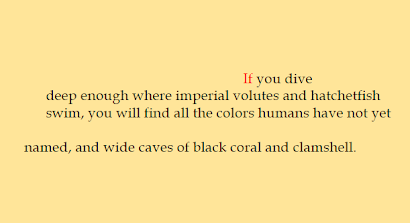
We can zoom in on one example from the poem to help students consider the effect of this type of sentence construction:


The sea imagery found in this conditional sentence contains a promise—if we dare to push ourselves beyond our comfort zones, whatever they may be in life, we might discover something previously unimagined, maybe even about ourselves.

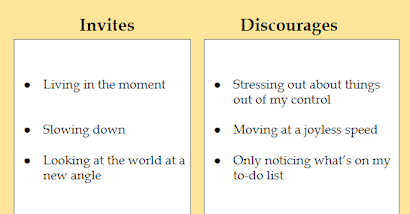
Your students can explore what it means for them to dive beyond the familiar by creating a simple T-chart. To get started, ask them to list what the poem’s imagery invites them to do on the left side. Then ask them to list what behavior or mindsets accepting that invitation would discourage on the right side.


Then model combining the two in a conditional sentence using “if” as my student does below:

If I slow down,
I will glimpse a jellyfish umbrella light up its sky,
who can teach me how to float and pulse at an easy speed.

Through paying attention to the poem’s conditional clauses, we can better appreciate the generative quality of the poem’s invitation: new mental terrain opens up, not grounded in the familiar and the routine. It might be fun to ask students to share their sentences in a wraparound (or invite the risk-takers in the room!).

Further Reading:


Xochitl Bentley is a high school English teacher and NBCT in Los Angeles, CA. She is a Co-director of the Cal State Northridge Writing Project and a contributing writer at Moving Writers. You can find her on Twitter @dispatches_b222.

Saturday, March 19, 2022

2022 Post #5 -- What I Learned

by Amy Ludwig VanDerwater

Every year, I send the same poem to my mother on March 8, her birthday. The poem is Julia Kasdorf’s What I Learned from My Mother. It is a list poem, and it begins with practical tips for life such as “...have plenty of vases on hand/in case you have to rush to the hospital/with peonies cut from the lawn” and ends with the big learning, “To every house you enter, you must offer/healing: a chocolate cake you baked yourself,/the blessing of your voice, your chaste touch.”

The speaker of this poem honors the mother with each chosen list item. We readers understand this mother, though nowhere are we told, “My mother was thoughtful.” After the last line, we are left to wonder if the mother is living or dead. Does it matter? Would the speaker remember differently if things were different now?

While this poem strikes a tone of love, “What I Learned” lines can be playful or serious, sad or curious:


I learned from my friend how to make bean soup for winter days.

I learned from onions how to let my sad old tears go free.

I learned from my dog that our backyard has thousands of smells!

I learned from my friend that forgiveness can hold anger in its arms.

I learned from the sky how to change every morning and still be me.


As poet, you may choose to write a one-person list poem as Julia Kasdorf did, or instead, you might make a “What I Learned” list in your notebook and then choose just one item to build a poem around.

Fine tune the interplay of meaning and sound of your poem by reading it aloud as you write and revise and revise again…

What have you learned? What will you learn next?


Further Reading: 


Amy Ludwig VanDerwater is a writing teacher and author of books for children and teachers. In person, you can find her at home in Western New York, and you can find her online HERE.

Friday, March 18, 2022

2022 Post #4 -- Language of the House

by Tim Reisert

In what language do you dream?

In grade school, half of my day was taught in French, the other half in English. Not typical for Cincinnati, Ohio. But there I was, sometimes a translator between my parents and my teachers from Belgium.

Bilingualism for me when young wasn’t without struggle, and moments of thinking in, even dreaming in, French were openings of doors. Though my French is now beyond rusty, my heart swells when my children (ages 10 and 7) use Spanish they have learned from their school.

Some questions for students:
  • What is it like to switch from one language to another? / What would it be like to be able to switch from one language to another?
  • What language(s) is/are spoken where you live? What words or phrases are unique to where you live?
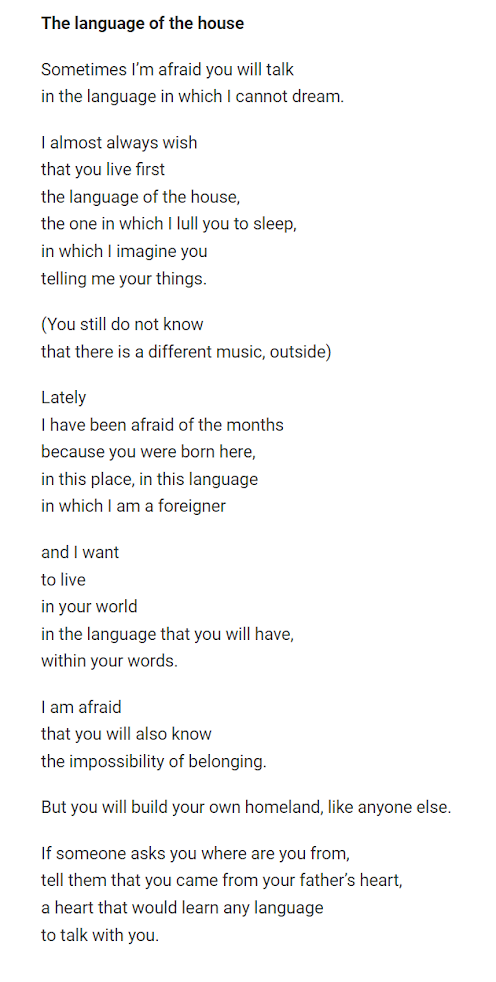
Manuel Iris writes about this topic in his poem, "The language of the house."


After reading Manuel Iris’s poem, have students discuss the speaker’s initial fear: “Sometimes I’m afraid you will talk / in the language in which I cannot dream.” How might the speaker’s relationship to a place where most use another language complicate the parent/child relationship and “the impossibility of belonging”? Also, students may discuss Iris’s use of “homeland.”

Try these ideas to invite student writing based on this poem:
  • Write about a word or phrase unique to where you live. How does this word or phrase describe your relationship to those around you?
  • Write a short poem in one language. Then translate it the best you can into another language.
  • If language is a house, then describe its rooms. Its doors. And who lives there.
Be sure to check out Iris’s bilingual performance of this poem and others from his collection The parting present / Lo que se ira. The poem in this lesson starts at 2:35.  


Here is a link to the collection The parting present / Lo que se ira. 


Further Reading: 


Tim Reisert teaches at St. Xavier High School in Cincinnati, Ohio. His poetry has appeared in Root & Star and participates with the Ohio Writing Project. (Twitter: @tdreisert; Instagram: @timreisert)

Thursday, March 17, 2022

2022 Post #3 -- Enough Ballrooms In You

 by Elizabeth Oosterheert

Culturally, we seem to find shipwrecks fascinating, whether the wreckage is actual or figurative.
Laura Lamb Brown Lavoie’s haunting poem “Titanic,” beautifully read by Sarah Kay, invites us to consider both–and not only to contemplate wreckage, but resilience.


There are myriad ways to invite students into this work and use it as a mentor for writing our own memorable poetry. Following are a few ways to dive into the waves with students and “swim” in a shimmering sea of words:

  • Share this brief video about the decay of Titanic’s wreckage. This gives students a good frame of reference for the descriptions in Lavoie’s poem of elements like Titanic’s stalactite beard, and it also illustrates the loneliness that lingers around the ship’s remains more than a century after her demise.
  • Provide students with a hard copy of the poem, and invite them to listen to this beautiful narration of “Titanic” by Sarah Kay, found on poetryfoundation.org and Ours Poetica.
  • Discuss craft moves such as the use of sound devices, lists, and the development of dialogue between the narrator and Titanic, and what students notice about this unusual conversation. I created this hyperdoc for my students to enrich our discussion.
  • This poem could serve as a bridge to other poems featuring conversations involving inanimate objects, such as Sarah Kay’s “Poem from a Toothbrush to a Bicycle Tire,” and a next step could be inviting students to try writing their own conversation poems. Encourage them to use some of the same powerful craft moves that they noticed in Lavoie’s poem. Interestingly, conversation poems also appear in Kwame Alexander’s beloved Newbery novel in verse, The Crossover.
Perhaps the most powerful aspect of “Titanic” is Lavoie’s reminder and charge to all of us to take the risk of being gouged open by love in a world that often feels sinister and isolating. In emptying ourselves sacrificially for the good of someone else, we become stronger.


Further Reading:


Elizabeth Oosterheert is a middle school language and theatre arts teacher in Central Iowa. Like the Titanic, she believes that sometimes, we have to sail into icebergs with courage and grace. You can find her on Twitter @oosterheerte, or on stage with her 8th Grade Theatre Troupe.

Wednesday, March 16, 2022

2022 Post #2 -- A Line or Two for Life

 by Brett Vogelsinger

Since Poem of the Day is a yearlong habit in my classroom, I feel it's important to weave in some of the best-known names in American poetry, but in a different way than students might encounter in other classes.  When we read "Stopping by Woods on a Snowy Evening" by Robert Frost, for example, I emphasize not interpretation, but rather appreciation of the poem's beautiful language. 

I say, "Today's poem is about a man who is driving a horse-drawn buggy past woods on a snowy evening. He pauses, reflects for a moment, then moves along on his way.  And that sounds like a pretty boring poem, I'll admit it, yet it's one of the most famouse poems we will read to start class this year. 

Tay Zonday's reading of the poem on The Poetry Foundation's Ours Poetica project is brief and wonderful, so I begin by sharing this video with my class: 


Then I say, "I have always loved the last four lines of this poem, just the sound they make.  My favorite of the four is this one: 'The woods are lovely, dark, and deep."  It's a line I think of every time I spend time in a forest, no matter the season.  Say it out loud with me: It's such a beautiful line to say aloud!" 

We say it a few times, and I share my beautiful Obvious State print (below) inspired by this quote. 


"Now here's what I'd like you to keep with you from this poem:  In your life, there will be many times you end up in the woods -- hiking, hunting, walking, or lost.  When you are, let this line run through your head: 'The woods are lovely, dark and deep.' Poems can be like that, ring in our ears years later.  I hope this line is like that for you as it has been for me." 

Additionally, I might add, "You know that last line, repeated twice -- that one just might run through your brain on those nights when you feel overwhelmed with things to do: 'And miles to go before I sleep,/And miles to go before I sleep.'" Every student knows a night like that at some point in high school. 

Further Reading:


Brett Vogelsinger is a ninth grade English teacher and NBCT at Holicong Middle School in Doylestown, PA. He is the founding editor of Go Poems, facilitates his school's literary magazine, Sevenatenine, and contributes monthly posts at Moving Writers. Follow him on Twitter @theVogelman.


Tuesday, March 15, 2022

2022 Post #1 -- The Magic of Ordinary Moments

by Allison Marchetti

Two years ago, I suggested the poem “The Return” by Jonathan Greene, for helping our students think about the grounding and comforting nature of rituals in times of upheaval.

This year, I offer “Abundance,” which contains a similar invitation. In this poem, Amy Schmidt argues that simple, everyday acts can evaporate loneliness and lead us to discover the bounty in our lives. I just can’t get enough of poems that zoom in on the magic of daily routines and ordinary moments. Plus, Schmidt dedicates this poem to Mary Oliver, one of my most cherished poets.

Here’s what working with this poem in your classroom might look like:


1. Read the poem out loud.

2. Discuss what you notice about the poem. Here are a few things that might come up, or that you might draw their attention to:

  • The title is an abstract noun, followed by a concrete description.
  • The poem consists of five very short sentences.
  • The poem is directed at a “you” and contains commands (scrape, look).
  • In one short sentence the poem illuminates how the simple act of zesting an orange can lead to noticing abundance: “Scrape…and the whole room fills…”
  • "S" sounds
  • Use of colon and fragments (“Always have”)

3. Then, encourage students to share everyday acts that could illuminate the big feelings we have. Could brushing our teeth somehow remind us to laugh? Wiping down the countertops bring a moment of clarity? How could some of the mundane acts of our lives inspire happiness, lightness, togetherness, courage – any number of positive feelings?

4. Finally, invite your students to write beside this poem, perhaps borrowing the frame:


It’s impossible to be ______________

when…


Look around: you

____________________________


You just didn’t notice

until now.


Further Reading: 


Allison Marchetti is co-author with Rebekah O’Dell of WRITING WITH MENTORS, BEYOND LITERARY ANALYSIS, and A TEACHER’S GUIDE TO MENTOR TEXTS (Heineman). She is the co-founder of Moving Writers, a blog for secondary writing teachers. She lives with her family in Richmond, Virginia.

Saturday, February 19, 2022

An Upcoming Webinar

 Dear Readers of Go Poems, 

I can't wait to share new posts with you starting March 15, 2022! The variety of bloggers, poems, and ideas shared here will take the blog to new heights in its final season, as we take our list of ideas to 180 -- one for every day of the school year. 

Additionally, I'm excited to announce that I will be presenting an online webinar for Moving Writers on March 23. Teachers can attend live -- I can't wait for some personal interaction with teachers far and wide -- or register in order to access the recording at their leisure. The cost is $25, and groups of ten or more are eligible for a group discount.  

Here is the link to learn more and to register.

Additionally, I blog about poetry pauses that help writers in any genre over at Moving Writers. Click here to read my posts.  

See you back here on March 15 . . . and maybe at the webinar too!