Thursday, March 29, 2018

2018 Poem #15 -- Personfication In Song

by Rita Kenefic

Many students have difficulty identifying  the various figures of speech. The lyrics to the song, "April, Come She Will" by Simon and Garfunkel are a wonderful example of personification  and can serve as a great way to reinforce this particular figure of speech. Additionally, I’ve found that students often don’t realize that song lyrics are actually poems. Once they understand this, it is likely to pique their interest in poetry.

First, copy the lyrics to "April, Come She Will" and distribute to students. Let students follow the lyrics, as you play the song.


Discuss how the lyrics personify the various months. Solicit students’ opinions of the effect the use of personification has on the poem.
Next, either suggest or have students brainstorm other categories that lend themselves to this kind of personification. Some examples are:  days of the week, holidays, seasons, decades of our life, etc.
Working either individually or in pairs, have students  pick a topic and write examples of personification in their writer's notebooks, using the song lyrics as a mentor text.
To follow up, you might encourage students to work on and complete their poems during independent writing time and share completed poems in some manner. Or you might choose to invite students to look at song lyrics as poems by identifying and sharing a song lyric that speaks to them.

Further Reading:


Rita Kenefic recently retired from position as a reading specialist in Central Bucks School District. Passionate about reading, writing and fostering literacy in the home.  Blogs at “Nurturing Literacy” http://www.helpurchildread.com/


Wednesday, March 28, 2018

2018 Poem #14 -- Voice of the Past

by Brett Vogelsinger

There is always something special about hearing a poet read his or her own words, and perhaps something extra special about hearing a recorded poet read these words posthumously.  This act reminds us that even the poems that end up commonly anthologized and in the canon are meant to be heard aloud, that they speak from the past most eloquently when we breathe life into them.

Langston Hughes poems frequently surface in student anthologies.  In this video, students have the chance to hear Langston Hughes talk about the experience that led him to write "The Negro Speaks of Rivers" as a young man just out of high school, and then he reads the poem aloud.


An intriguing video to pair with this: a contemporary high school student recites the same poem in the twenty-first century for the Poetry Out Loud competition: 


Three questions to discuss with students after sharing this poem:


  • How does knowing the background of the poem and hearing it in the writer's own voice affect our experience with the poem?  
  • How does listening to a poem written nearly one hundred years ago give voice to the past? 
  • How does the content of the poem give voice to the poet's past? 

Further Reading:


Brett Vogelsinger is a ninth-grade English teacher at Holicong Middle School in Bucks County, PA.  He is the faculty adviser for the school literary magazine, Sevenatenine.  Besides his annual blogging adventure on this site, he has published work on Nerdy Book Club, The New York Times Learning Network, and Edutopia and you can follow him on Twitter (@theVogelman).

Tuesday, March 27, 2018

2018 Poem #13 -- Wait, Rappers Are Poets?

by Zachary Sibel

This year I wanted to try something new when it came to teaching poetry, so I made a strange connection. I thought about what I like to eat when I go out. I realized that most the time my favorite items to order are appetizers; they are smaller portions, you get a variety of choices, and when you put the right combination together, you are rewarded with an experience that is filling. 

I decided to present poetry from various classes and movements to my students in the same way. I used three to five poems from the Romantic, Victorian, Modern, Postmodern, and Contemporary eras of poetry. I found that my students were more engaged when they got to read through and pick the one that stood out to them, rather than sit down and talk about them all.

One poem that really topped them all when it came to student engagement was Tupac’s "A Rose That Grew From Concrete." I present this poem with no context of who Tupac was (or still is, that is up for debate) and just focus on language and the use of metaphor. After reading the poem aloud twice, I ask students to dig into the imagery and symbolism of this poem. The beauty of this poem is it impacts students of all backgrounds and upbringings. 

This year I had a number of students connect with it, one of whom discussed the idea that, “the only person who needs to believe in you is you, " a rather sophisticated reflection for a middle school student to have. I let the students carry the discussion, and when I see it fit, I end with providing a little background as to who Tupac was, the idea of West Coast rap, and how language can be used to examine various social issues.

Additional fun: I focus a lot on the questions, “Is all music poetry? Is all poetry musical?" With Bob Dylan winning a Nobel Prize for literature, the question begs to be answered or at least discussed. After showing students "A Rose That Grew From Concrete," we play a little Kahoot game that requires students to read a line of verse/lyric and determine if it is poetry or hip-hop. Students find themselves recognizing some of the lyrics but not all. They realize that the distinction between hip-hop and poetry is more complex than we may originally think.

Further Reading:


Zachary Sibel is a hip-hop fan, English teacher, and department chair at Central Bucks West High School in Bucks County, PA. 

Monday, March 26, 2018

2018 Poem #12 -- Letter to the Future

by Tyler Kline

In this exercise, students write a letter to a person living fifty years in the future.  First, read Matthew Olzmann's poem “Letter to Someone Living Fifty Years From Now” as a mentor text.

Students may write the letter to a specific person or to an anonymous "someone" like Olzmann does.  Encourage students to consider what they want to tell this person living in the future with some of the following prompts:  Do you want to share information about what is going on in the world right now?   Current events?  Celebrity gossip?  Do you want to share a fear, dream, wish or thought that you currently have?  Remind students that their letter do not have to be about anything monumental (example: Olzmann writes about animals becoming extinct) but what students write about should be significant to THEM.

As they write, encourage students to include a question to the future reader, something they would like to know from this person.  For example: "Do you still have the McDonald's Dollar Menu?" or "Who is on the one-hundred-dollar bill?" or "Are robots friendly?"

Olzmann ends his poem with the powerful line, "And then all the bees were dead."  Students can choose to end on any type of note they want -- inspiring, hopeful, forlorn, confused, etc.  Whatever their choice, encourage students to craft a last line that is as impactful as possible and to write this line in a separate stanza.

If time permits for discussion, students can share their poems with a partner.  The conference partner can pretend to be the reader fifty years from now and predict how this future reader would respond to the poem. 

Further Reading:


Tyler Kline is a teacher and writer from Pennsylvania.  In 2015, he was named the Poet Laureate of Bucks County, PA. 

Sunday, March 25, 2018

2018 Poem #11 -- Crossing Genre Borders

by Charles Moore

In my experience, and maybe in yours as well, our students do not connect to non-fiction on the same level that they do with poetry.

I decided to try to address this lack of connection by using poetry to show how connected we can be with our reading lives.

Our unit would give us the opportunity to explore the research process, and we began by reading reviews.  We looked at a video game review, a movie review, a piece by Leonard Pitts and this review  that weighs the merits of our current poetry culture.

The students can notice important parts of the articles and respond to them with their thinking but they could not even fake an emotional connection to the articles no matter how hard I pushed.

We talk about poetry often in my classroom.  It is easy for me to ask the kids to respond to a poem in their writers’ notebooks, and I see them pour their thinking on to pages.  The connections they make are incredible.  They are good at it.

So I began one day with this poem, posted on Instagram by Rupi Kaur:

We talked about the poem and they noticed how it drove their thinking on an emotional level.

We talked about that reaction. Specifically, we examined how texts other than poetry can have an impact on us.  We talked about trying to use this type of connection in our reading of non-fiction texts.  

As we reached back to non-fiction, we were able to make deeper and more meaningful connections to the text, and it showed in our writing.

Don’t be afraid to leverage poetry in the instruction of other types of writing.  No matter what we think of this current generation of learners, poetry reaches them like it reaches those that came before them. 

Further Reading:


Charles Moore teaches Senior English in League City, TX.  His daily poetry picks are the most fun part of his lesson planning. 

Saturday, March 24, 2018

2018 Poem #10 -- Easy Essaying About A Poem

by Katherine Bomer
I think poems and true essays (not the five-paragraph formula) share several features, for instance how they invite readers to make different meanings and bring varied interpretations to them.  So it makes sense to use informal essaying, or writing to think, as one way to demonstrate that poems can have multiple interpretations.

I choose an evocative, slightly mysterious poem, preferably unrhymed. Perhaps a poem that starts one place and ends up in another, or a poem that has a title that sets up a scenario in your mind, but then the body of the poem takes you to another, even an opposite place. "Commercial Break" by Jacqueline Woodson is a great one to use with middle school students.

I read and show the title by itself first. I ask students to write what they are thinking in their Writer's Notebooks for just one minute, asking several open-ended questions as invitations for students to follow their thinking, not as a checklist or requirement to answer each one. What are you anticipating? What are you noticing? What images arise? What questions or confusions arise?

Next, I read aloud and project the first stanza, or the first 1/3 if a poem is structured in one stanza. I ask them to write for two minutes: now what are you noticing/anticipating/wondering? How is your thinking changing?

I repeat this process, revealing only a stanza or two, or another 1/3 of a poem, until reaching the end, when I ask: now what are you making of this poem? How and why did your thinking change?

Students share their mini-essays with partners or small groups and we talk about the multiple pathways to a single poem. If the poem has enough depth or edge, it can often lead to powerful class discussions and even to future essay writing!

For high school students, try “Poppies” by Jennifer Grotz.  

Further Reading:


Katherine Bomer writes about helping students learn to love writing. Her book The Journey Is Everything investigates how teachers can make essay writing a highlight of their students' writing experience.

Friday, March 23, 2018

Poem #9 -- As Easy As ABC . . . Or As Challenging

by Brett Vogelsinger

An abecedary is an inscription of the letters of the alphabet, often in order, and often used as a practice exercise, so technically every student who has studied the English language has completed an abecedary at some point early on in their education in order to learn the alphabet.  In fact, there is even a related word to describe people learning the alphabet: abecedarians.  That sounds so much more accomplished than "kindergarteners," does it not?

Gabriel Fried's poem, "Abecedary," is somewhat more challenging.  Each word begins with a consecutive letter of the alphabet, yet it makes fantastic, whimsical sense as a series of commands or instructions for debonair elves and mighty newish otters.

Here is the poem:

Abecedary
by Gabriel Fried

Apple-
Bodied
Child,
Debonair
Elf,
Forage
Gently
Here
In
Jasmine
Keeled
Latitudes.
Mighty
Newish
Otter,
Pray
Quietly.
Retrieve
Sapphires.
Trundle
Under
Violets
Within
Xanadu,
Young
Zodiac.


The poem looks like it must have been easy to write at first, much like some abstract paintings in a museum may make some visitors feel like, "Well I can do that!"  So challenge students to create an abecedary that makes some sense, maybe even as a set of instructions like this poem.  In five minutes, they will discover the challenge.

The goal here is not for every student to complete a perfect Abecedary, but rather to grapple in their writer's notebooks with this structure and see how an excellent poet can make a challenge look deceptively simple.

Further Reading:


Brett Vogelsinger is a ninth-grade English teacher at Holicong Middle School in Bucks County, PA.  He is the faculty adviser for the school literary magazine, Sevenatenine.  Besides his annual blogging adventure on this site, he has published work on Nerdy Book Club, The New York Times Learning Network, and Edutopia and you can follow him on Twitter (@theVogelman).

Thursday, March 22, 2018

2018 Poem #8 -- The Power of Poetry

by Travis Crowder

So often, I find that students have a tenuous relationship with poetry. I expose students all year to poems, showing them how to unpack, create, and write about the things that are meaningful to them, the things that interest them. Most often, I find that students will grapple with more difficult poems if they have been given the opportunity to write their own.


Writing their own poetry, though, requires patience and guidance, especially if you work with reluctant readers and writers. I find that many students love writing in non-traditional formats, especially concrete poetry. I introduce nontraditional poetry early in the year, and as the year progresses, I give students chances to write poems that break traditional forms. I love using Allan Wolf’s writing as a starting point because he is an accessible poet, but he also deconstructs traditional forms to engage readers.  


I ask students to jot down these questions…


1. What do I see?
2. What do I hear?
3. What do I feel?
4. What do I smell?
5. What do I think?

...and begin adding their thinking.


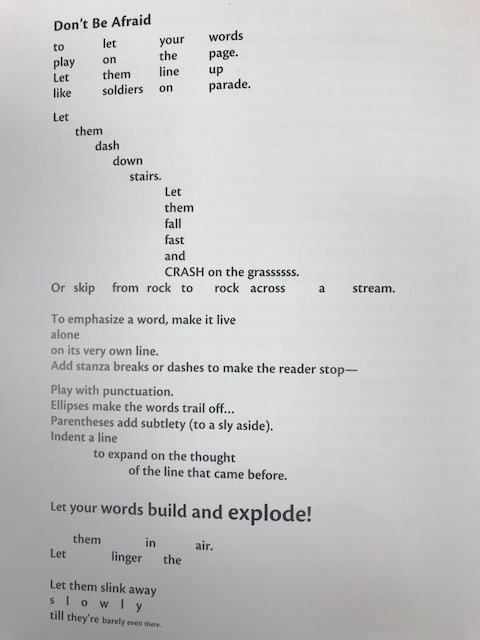
Afterward, I display "Don't Be Afraid" by Allan Wolf. It is a segment from Immersed in Verse, a beautiful book of lyricism that invites any writer into the world of writing poetry.

Image taken from Allan Wolf's website, linked above. 

For a few minutes, we discuss how Wolf modifies font size, style, and spacing to match topics and ideas within his poems. Students are always mesmerized by the variations in style and are eager to create their own.


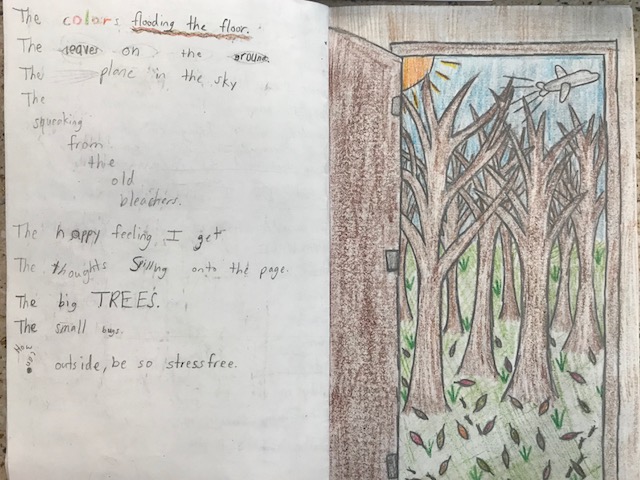
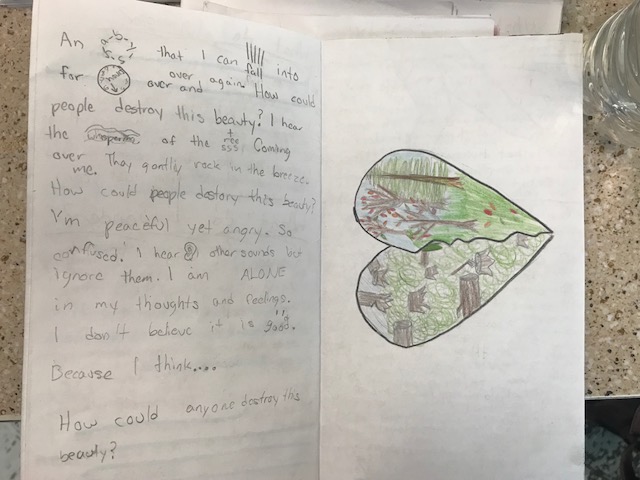
So I let them. And they use the things they saw, heard, felt, smelled, and thought as the foundation for their poems.   


I give them time to play with language, with style, with spacing, and with imagery, much like the poem from Allan Wolf. It is here that students begin to understand purpose, tone, and how poetry can push us past the ostensible. Give them a chance to create. And be prepared to stand in awe of their creations, such as the examples below:


Further Reading:


Travis Crowder is a 7th grade ELA teacher in Hiddenite, NC, teaching ten years in both middle and high school settings. His main goal is to inspire a passion for reading and writing in students. You can follow his work on Twitter (@teachermantrav) and his blog: www.teachermantrav.com/blog.